

Can Pandemic Perpetual Bonds be considered a fruitful opportunity for wealth investors? The sixth black swan in 40 years originated in February 2020, due to a sanitary cause. About the others, 3 were caused by financial motivations (1987-1998-2008) and the remaining 2 by war events (1990 and 2001). Black swan is a symbology that identifies an unexpected event able to impact upon a financial cycle, creating a drawdown with an unforeseeable shortfall in stock and/or bond markets.

Sincerely, I do not agree with the nickname “pandemic” and I prefer terms as Health Bonds or Recovery Fund, more pleasant for our “financial mind”. Bonds are a single-choice, funds are a multiple and diversified one. However, the essence of the question is how long it takes a crisis to recover from the drawdown. Sometimes a few months (when the originating cause is not a black swan but a dirty white one), sometimes many years, like after 1929, where it lasts until 1954!

In order to satisfy the requested volume of financial sources, it is preferable to issue very-long-term or perpetual securities. As the best, there are stocks (uneven and risk taker), non-refundable loans or contingent convertible bonds (CoCo bonds). Anyway, the availability of the funds must be longer than the expected payback of the needed expenses and investments. As far as toda,y we do not know the expected maturity of those needs. Some readers could ask themselves which interests and risks lie under a very long-term investment like a perpetual or a 40/50-year maturity bond. The first answer is volatility, which is the probability of a wide range of expected results all along the existence of the securities, hoping for the bes,t picking and managing knowingly the risk of the worst contingencies. Another reason refers to the unusually long period of low interest rates that began twenty years ago, decreasing expectations of immediate return from investments in debt securities.
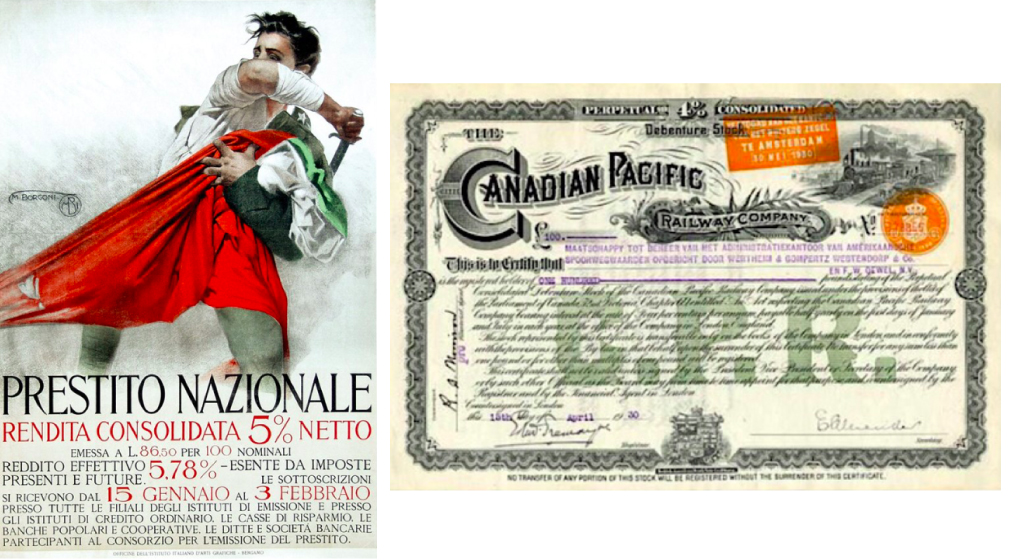
Extending the length of the investments, the expected return increases according to the normal shape of the yield curve. If the market value of the bond decreases, according to an increase in interest rates in the bond market (not feasible in the short term), the price of perpetuals becomes more interesting, incorporating a growing expectation of TRES (the actual yield that is the most effective measure of return for any investment). In a very long horizon (the preferred one for investors like pension funds, insurance companies and wealth savvy investors), this view is by far preferable in a rational approach. Nonetheless, we need to take into account that the behaviour of many investors is irrational, and this influences the actual portfolio management for most of us.

Our brain suggests, but our belly tends to refuse this advisory! Nonetheless, my professional commitment is to recommend, when possible, to consider this solution for ourselves and for the post-crisis management. For sure, from a macro-economic point of view, hopefully for private investors. The result is an attractive combination!
Article edited by Giuseppe G. Santorsola
Full Professor of Asset Management
Corporate Finance and Corporate & Investment Banking
Parthenope University of Naples