What makes a jewel contemporary today? Not only form, concept, or the use of unexpected materials. The most interesting jewelry often emerges in the way a material is chosen, transformed and brought back to the body.
PREZIOSA YOUNG 2026, the international competition organized by LAO, Le Arti Orafe Contemporary Jewellery School in Florence, offers a precise view of this shift. Founded by Giò Carbone in 1985, LAO was the first Italian educational institution dedicated to contemporary goldsmithing. Preziosa Young was launched in 2008 as part of the broader PREZIOSA project, which in 2015 became Florence Jewellery Week, the first jewelry week in Italy. Over the years, the competition has become a platform for artists under 35, offering visibility, recognition and professional opportunities through collaborations with partner institutions.
Curator Alice Rendon explains the spirit of the project in these words: ” The large number of applications from around the world and the enthusiastic response of collaborators and supporters once again confirm, this year, the strength and success of this ambitious project. PY was born from the shared passion of its founders — Giò Carbone and the late art historian Maria Cristina Bergesio — for research in the field of jewelry, at a time when young talents still needed a powerful platform to make their voices heard.” The ex aequo winners of the 2026 edition are the designers and goldsmiths Lois Lo, Nga Ching Ko, Lulu Tian and Jiangling Wang. Their works were selected through a free and anonymous application process, a rule in place since the first edition to guarantee fairness and transparency. The international jury evaluated the projects for design quality, craftsmanship, contemporary use of techniques and materials, originality and conceptual innovation.
Chaired by Giò Carbone, founder and coordinator of the PREZIOSA, Florence Jewellery Week and PREZIOSA YOUNG projects, the jury brought together a broad range of voices from the jewelry field: Alice Rendon, art historian; Maria Laura La Mantia, jewelry historian; Laura Helena Aureli, founder of Lost In Jewellery Magazine and MyDayByDay Gallery in Rome; Farieda Nazier, artist and curator of the FADA Gallery at the University of Johannesburg; Irina Probst, Exhibition Manager of INHORGENTA Munich; Laura Astrologo Porché, jewelry journalist and founder of Journal des Bijoux; Bryna Pomp, director of MAD About Jewelry at the Museum of Arts and Design in New York; Zhipeng Wang, jewelry artist and winner of PREZIOSA YOUNG 2021; and the directors of the galleries involved in the exhibition, Thereza Pedrosa, Doreen Timmers and Petra Brenner.
The strength of this competition lies not only in the selection of the winners, but in the life given to the works after the award. The 2026 edition unfolds as an international traveling exhibition, accompanied by a bilingual catalogue in English and Italian, published by LAO and freely available on the Preziosa website. The catalogue includes high-resolution images, critical texts by Alice Rendon, lecturer in History of Contemporary Jewelry at LAO, and Maria Laura La Mantia, lecturer in Jewelry Culture at the same school, as well as contributions by Petra Brenner, Zhipeng Wang, Farieda Nazier and the winning artists. The exhibition began its journey in Florence during MIDA (International Handicraft Exhibition) now in its 90th edition, from April 25 to May 3, 2026. The show was installed in the Sala della Volta, transformed for the occasion into a space entirely dedicated to LAO. From Florence, it traveled to SCHMUCKE Galerie in Berlin, directed by Petra Brenner, where it is on view from May 23 to June 13, 2026. The next stop will be Galerie Door by Doreen Timmers in Nijmegen, the Netherlands, from July 11 to August 1, 2026, before the exhibition returns to Italy in the fall, closing at Thereza Pedrosa Gallery in Asolo from November 7 to 29, 2026.
This journey gives the selected artists more than a single moment of visibility. It places their work in different contexts: a historic craft fair and specialized contemporary jewelry galleries. For a young artist, this kind of circulation can be as important as the award itself. The four winners are very different from one another. Yet, together they outline some of the directions in contemporary jewelry today: the reinvention of the gemstone, the second life of discarded textiles, the use of biomaterials and the return of hand-built structure.
Lois Lo (Hong Kong, 1998) approaches jewelry through architecture, light and perception. Her pieces Wall and Greenhouse are made with medical-grade stainless steel, smoky quartz, white topaz and oxidized sterling silver, using stone cutting and processing, polishing, creative setting and laser welding. Lo is interested in architectural elements such as shutters, windows and bricks, and in the way they frame light and space. Tadao Ando is an important reference for her disciplined use of light and shadow. Technically, her work questions the traditional hierarchy between gem and setting. Each stone is individually carved to receive its own setting, turning the gemstone from decorative center into structural element. Lois Lo received the INHORGENTA Prize, awarded by Irina Probst, which grants her a free exhibition space at the Munich fair in 2027.
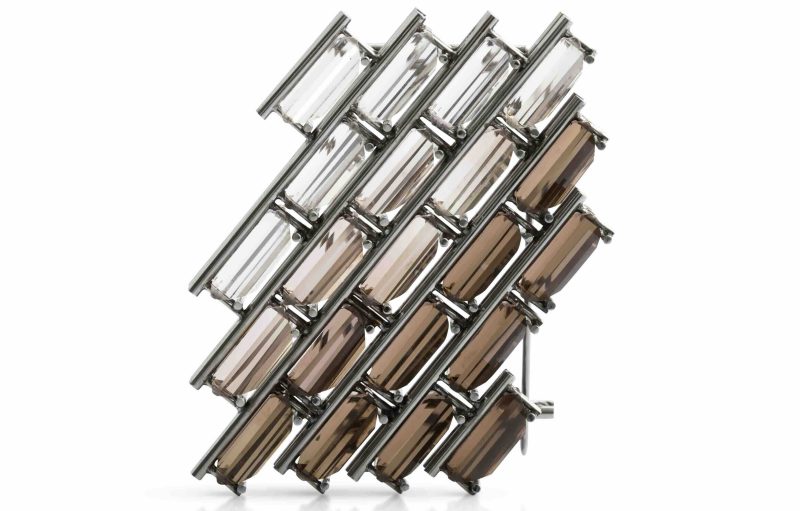
Lois Lo, Wall brooch – ph. credit Jenny LLewellyn
Where Lo starts from architecture and light, Nga Ching Ko (Hong Kong, 1993) begins with textile memory. Her Replay series gives new life to second-hand garments, turning discarded clothes into jewelry and bringing them back to the body in another form. Her works Two Blues and Yellow Worm combine polyester, wood, 925 silver and stainless steel. They are made using kimekomi, woodworking and silversmithing. The kimekomi technique, traditionally associated with Japanese dolls, allows fabric to move from softness to structure. Ko does not simply recycle textile. She changes its status, transforming clothing into material, memory and ornament.
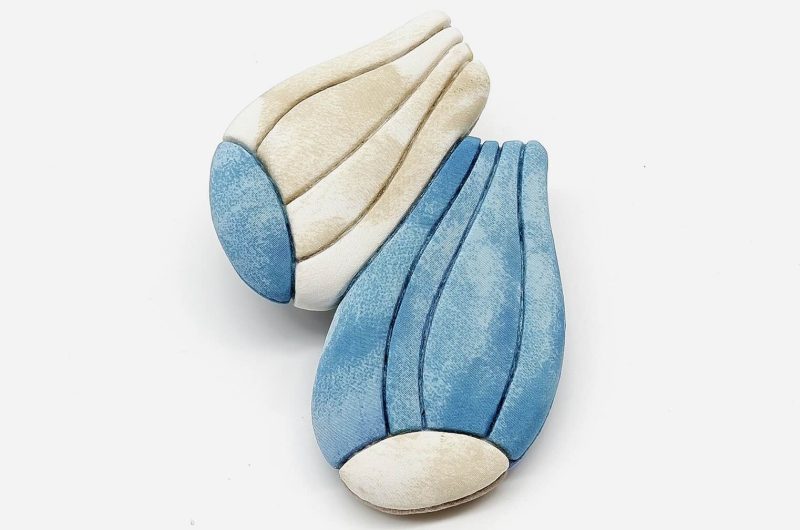
Nga Ching Ko – Two Blues brooch
If Ko works with what has already been worn, Lulu Tian (China, 2003) moves toward another kind of discarded matter: fishery waste. Her project uses fish-scale bioplastic, a biodegradable material she developed from fish scales, bringing together goldsmithing, biomaterials and the marine cycle. Works such as Biotic Loop I and Soft Clusters II, from the series When The Ocean Left Its Dead Alive, use fish scales, glycerine, natural dyes such as madder, walnut, brazilwood and weld. They are made through laser cutting and slotting. Their modular forms recall algae, plankton and coral polyps. Tian’s work challenges one of jewelry’s oldest assumptions: permanence. Her pieces are designed to change, degrade and return to the earth, asking whether preciousness can also be temporary, ecological and alive.
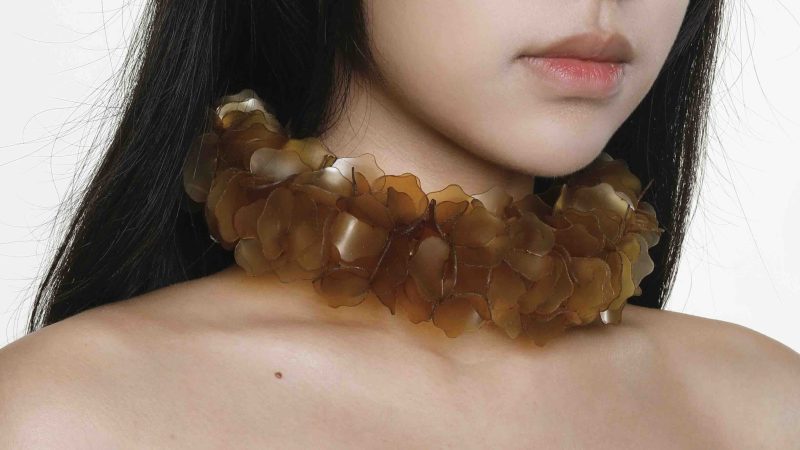
Lulu Tian, choker – Ocean Left Its Dead Alive
Lulu Tian received two special awards: the MyDayByDay Gallery Prize, offered by Laura Helena Aureli, which includes five days of promotion and a dedicated page on the gallery’s website, and the Journal des Bijoux Prize, awarded by Laura Astrologo Porché, who dedicated a post to the artist on the Instagram and LinkedIn channels of Journal des Bijoux platform.
After Lo’s architectural stones, Ko’s textile memory and Tian’s biodegradable marine matter, Jiangling Wang (China, 1991) brings the discussion back to metal, but strips it of its usual rigidity. In her CANG collection, fine silver wire is drawn, hand-twisted, hand-woven, assembled and structurally formed until metal begins to behave almost like fabric. Works such as Flow, a necklace, and Construct, a brooch, are made from fine silver wire and steel wire, using drawing, hand-twisting, hand-weaving, structural forming and custom tools. The title CANG refers to ideas of hiding, concealing, preserving and protecting. The pieces have a quiet intensity: they do not display force, they hold it.
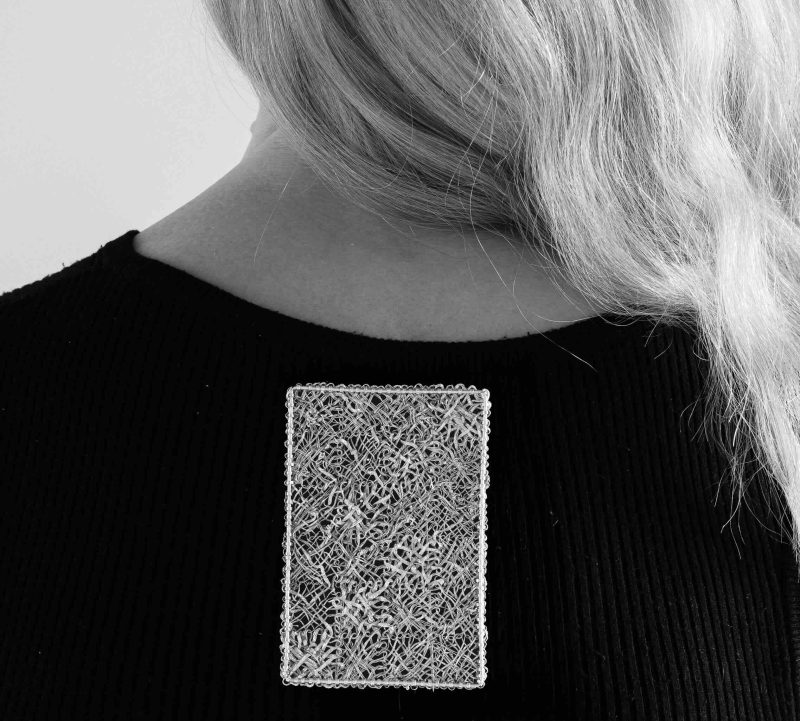
Jiangling Wang , necklace Flow – CANG series – ph. credit Ming Zhu
A distinctive part of Wang’s practice is her use of self-made tools, which she considers active participants in the making process. They shape resistance, rhythm and tactility, bringing attention back to the intelligence of hand, tool and repeated gesture. Jiangling Wang is also the winner of the LAO Special Prize, which will bring her to Florence for a one-week artistic residency in November, with accommodation provided by the school and full access to its workshops. During the residency, she will present her work and creative process to LAO students. At the end of her stay, she will be invited to donate one of the works shown in the traveling exhibition to the LAO contemporary jewelry collection, built over the years through acquisitions linked to the various editions of Preziosa Young. Wang also received the Lost In Jewellery Magazine Prize, awarded by Laura Helena Aureli, which includes five days of social media promotion and a dedicated page on LIJM’s “A Room with a View” website. Seen together, the four projects show a field moving beyond the old opposition between precious and non-precious materials. What matters now is not only what a material is worth, but what it can carry: memory, labor, ecology, light, cultural knowledge and bodily experience. A carved topaz, a recovered textile, a sheet of fish-scale bioplastic, a hand-twisted silver wire: in PREZIOSA YOUNG 2026, each material is pushed beyond its expected identity. This is where much of the vitality of contemporary jewelry lies today. Not in rejecting beauty, but in asking beauty to become more intelligent.
The project is already looking toward its next edition. The new call for PREZIOSA YOUNG 2027 is currently being prepared and will soon be launched on the LAO platforms, including https://artiorafe.it – www.preziosa.org, and the official social media channels: Facebook and Instagram @preziosa_fjw_exhibition.
This competition remains valuable because it does more than award young artists. It gives their work a professional frame, an exhibition path and a critical context.
Discover more @ https://www.preziosa.org
Article edited by Laura Astrologo Porché
Instagram @journaldesbijoux