
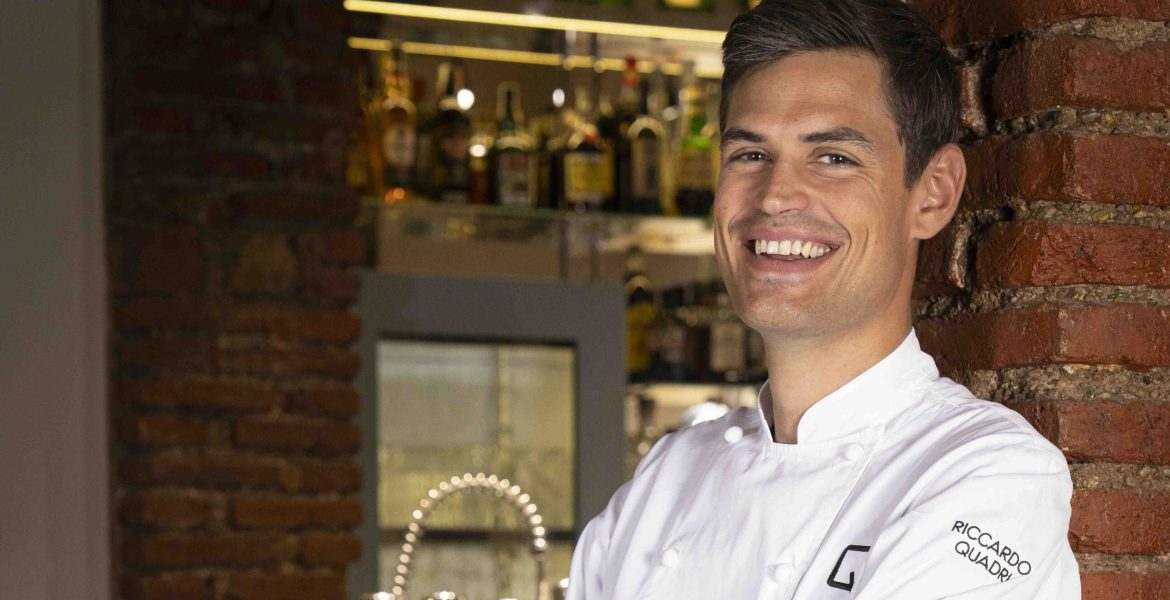
When chef Riccardo Quadri decided to open his restaurant, his greatest wish was for it to reflect his personality and be a place capable of conveying the idea of movement as a process of constant evolution – the guiding philosophy behind his dishes and menus. The former are the result of constant research and development, where every detail is carefully considered, refined and highlighted, whilst the latter are always so varied that the tasting menu has been named ‘In movimento’ (On the move).
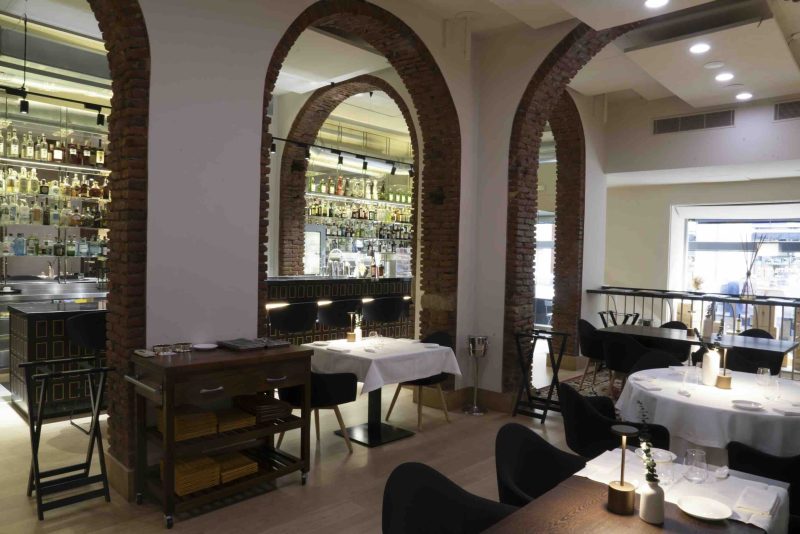
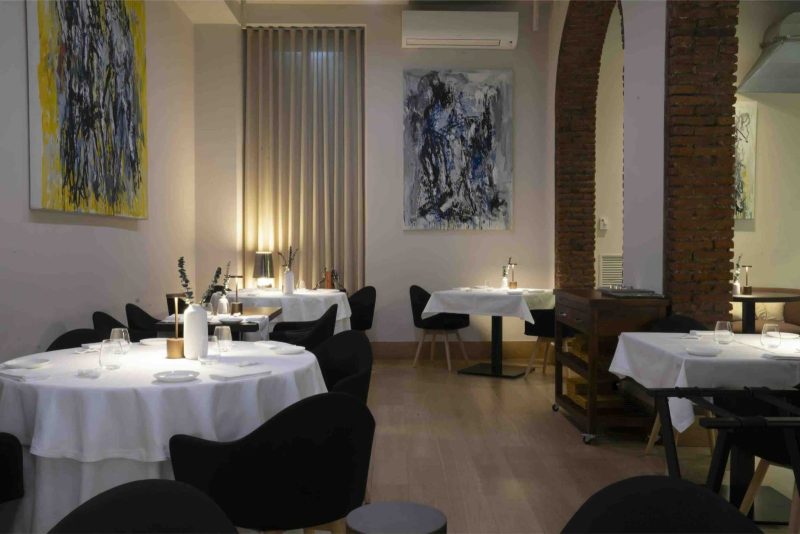
In 2022, Quadri Bistrot opened its doors in Brera, a historic and cultural district of Milan and once a hub for artists, in a setting characterised by exposed brick vaults and subtle tones, where a creative flair is evident, much like an art gallery, featuring paintings by the German artist Klaus Prior, who had previously exhibited in this very part of the city. Here, Riccardo’s passion for cooking and his vision of how to bring it to life have taken shape through an interplay of flavours and textures that take the palate on a journey through memory, discovery and diverse paths – not only culinary but also convivial.
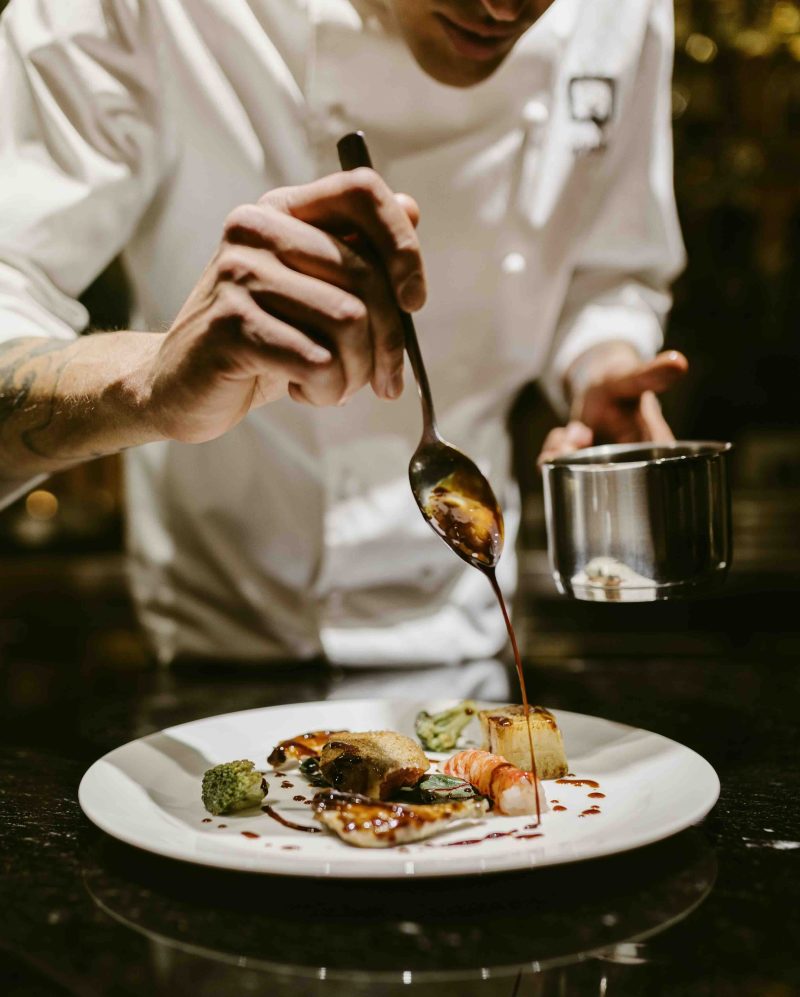
The realisation that cooking was his greatest passion came after he had become convinced that his life’s passion lay in economics, which he had studied in London. Riccardo Quadri, born in 1994, was captivated by the renowned Gualtiero Marchesi and his quest for the finest ingredients to cook in a way that enhances their flavour, and began working in Dario Ranza’s kitchen at Villa Principe Leopoldo in Lugano, his hometown. During his career, among other things, he was part of Carlo Cracco’s team in Milan at Carlo e Camilla in Segheria and Cracco in Galleria, and worked as his sous chef in Portofino.
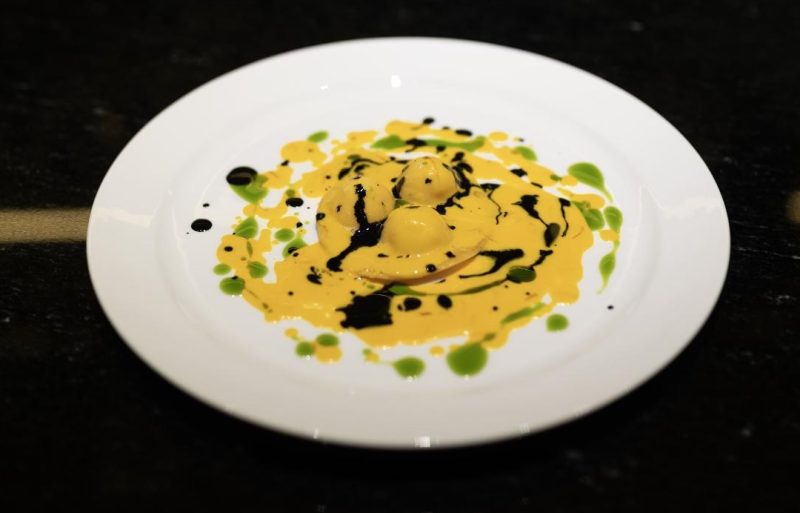
There are two dishes in particular that the chef likes to describe as his signature dishes; they say more about him than any others, not least in terms of the quality of their ingredients. Firstly, the ‘ravioli 3×3’, which reflects his journey between Swiss roots, Italian character and French tradition, and pays homage to the Lombard city that welcomed him: it is a ravioli made from egg pasta, classic in its Italian style, but with the distinctive feature of being stuffed three times. Cooked in salted water and then tossed in a delicate emulsion of Normandy butter, the heart of the dish is a homemade curd made from milk sourced from a local dairy. This is accompanied by three sauces: a light saffron velouté, a squid ink sauce and an aromatic basil oil.
Secondly, the ‘Quadri Bistrot beef tartare’, which also draws on Quadri’s culinary heritage but with a different focus: hand-chopped Piedmontese Fassona beef dressed in the classic style with oil, salt and pepper, to which sanded lentils are added, offering a unique sensory experience. At the base of the plate, where the tartare is placed, lies a slice of foie gras torchon, handmade at the Bistrot to evoke the tradition of raw meat served with butter, here reinterpreted through the foie gras. The dish is completed by a gel made from Stefano Antonucci’s Verdicchio passito, bay leaf powder and a Lambrusco reduction.
The chef recommends pairing the ravioli with Bianco Orto di Venezia to bring out the aroma of the saffron, and the tartare with Giacomo Conterno’s Barbera d’Alba Vigna Francia. Wines are, in fact, another of Riccardo’s passions, and the restaurant’s cellar is well worth noting, with 2,500 bottles comprising 410 different wines from Italy, Switzerland, France, Spain, Austria and the United States, as well as an equal number of spirits, liqueurs and vermouths.

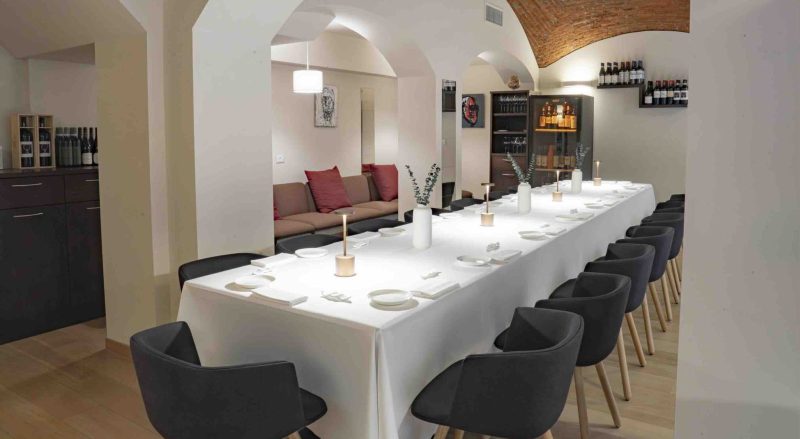
The refined cuisine of Quadri Bistrot – which has been awarded two forks in the Gambero Rosso guide since 2023 and has featured in the Michelin Guide since 2024 – is complemented by a variety of spaces, such as the cocktail bar, where classic mixology creations are prepared for aperitifs, and the quiet corner for a relaxing break or remote working, depending on the guest’s preference. There is also an outdoor terrace set in Via Solferino and a space on the lower level overlooking a citrus garden used for private events, featuring an imperial table in the centre and conversation sofas lining the walls. These elements add variety to the space whilst maintaining a sense of harmony.
Article edited by Claudia Chiari