
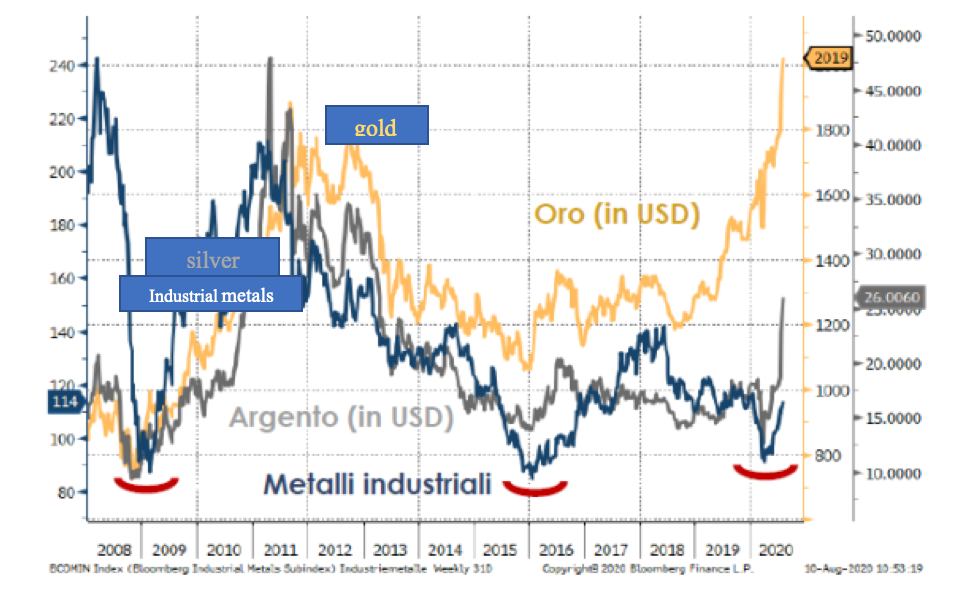
Gold has been the commodity with the highest rising prices during the first half of 2020. Only US Treasury bonds, in the field of financial asset classes, narrowed its performance, even if with a slower pace. Nonetheless, many financial assets recovered after the first quarter, but the gold price was not affected by these events, maintaining its values and, more, a growing trend around 2000$ ozt (oncia troy = 31,1034768 grams).
Usually, gold performs anti-cyclically when financial assets are under pressure, as a defensive investment. Under the pandemic COVID-19 the behaviour was different from the two classes moving with a positive correlation, after the divergent first two weeks in March.
Gold is a unique commodity with many functions, as industrial raw material, as currency reserve and as a speculative asset, moved mainly by countries where mines are substantial.
As a raw material, its use is historically decreasing. An example for my generation: my grandmother jewels were full of gold with a limited value-added generated by handcrafters, my mother’s ones contained less gold and more value-added, my wife’s ones contain less gold and a significative amount of handcrafters’ job. As a whole, the use of the material in jewellery is not actually a determinant in the creation of current quotations, while in the past contributed to the stabilization of the demand. The same happened in the industries of medals, trophies, orthodontics and electrical components (gold is a perfect conductor with high resistance).
In the field of reserves, data show a stabilization in several countries and some of these used gold as source able to correct disequilibria in commercial and financial balances of payments, especially for countries with consistent extraction of crude gold from their mines, frequently sellers of volatile quantities with significative impact upon market prices. Countries like Russia and South Africa are the two most involved.
In the area of speculative movements, statistics show the most consistent movements not hindered by other segments. This condition motivates the growing volatility of prices in the last quarter and the decline of the commodity as an anchorage during unstable scenarios.

Another interesting point of the analysis is offered by the behaviour in the past of my family company, where my father was a buyer of 12,5 kilos gold bars in the bullion market for industrial uses (400ozt each, 802.000$ at current prices). The average quantity he bought on monthly basis is now sufficient for half a year, even with the amount of total revenue that is tripled according to the business strategy and model adopted by the new management of the company. In terms of costs ranking in the income statement, gold is now the fourth item, after salaries (currently 40 employees against 150 in the past), artists compensations and purchases of other raw materials.
An interesting segment is still covered by the collection of coins like a gold sovereign in pounds, Krugerrands (1800/2000$ as with the content of 31.1034768 grams of gold), pesos and dollars and other past currencies or small bars of few ounces whose price is determined by the content of gold and the related price of the commodity.
Only for a more complete analysis, we could consider investment funds, unit trusts and e.t.f./e.t.c., fully or partially dedicated to investments in gold. Morningstar dedicates a category of its classification to stock&precious metals. Less interest is shown by gold-bearing stocks, once a significative asset class in the portfolio of institutional investors.
The last point of attention is given by the gold merchants (in Italy “Compro e Vendo Oro”, classified as special financial intermediaries, authorized and supervised by the central bank, submitted to anti-money laundering controls, but able to create wide bid/offer spreads that testify an unstable asymmetry in the matching of supply and demand. The segment shows still a high turnover of the operators and a very short average life, two indicators of the need for more regulation (that doesn’t mean much regulation).
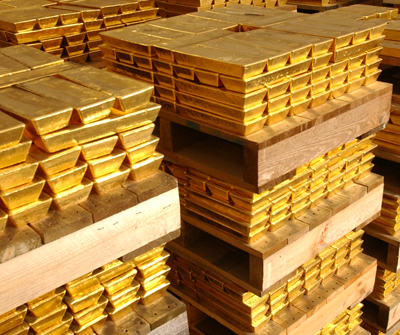
In the view of Authorities, “the Fed can’t print gold” is a current sentence of these months, as an answer to the impressive amount of money issued and put into circulation after February 2020. According to this view, many analysts (not all) forecast a price near to 3000$ per ounce within the end of 2021; gold is physical, banknotes (since the beginning of XX Century) are only paper or “flat money”. On the contrary, 3000$ could be only a target price, read as a suggestion for selling. However, only the future will tell us if this is the theory or the natural sequence of markets answers will show a different solution; the economy is not normal in these times!
by Giuseppe G. Santorsola
Full Professor of Asset Management
Corporate Finance and Corporate & Investment Banking
Parthenope University of Naples