
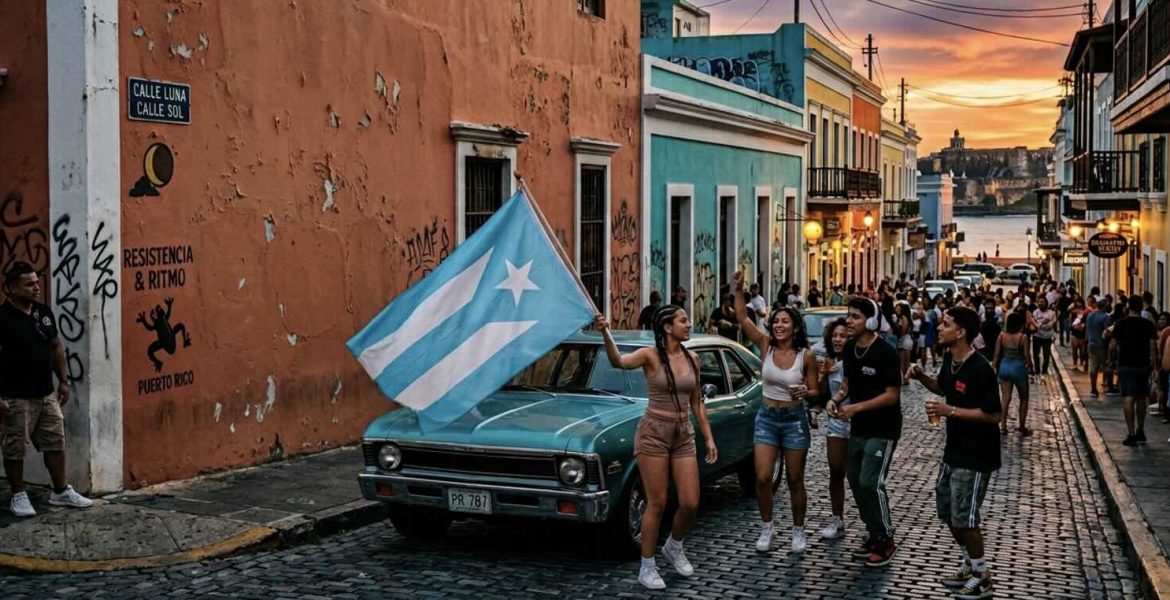
There are 500 million listeners streaming reggaeton every day, but few artists command that attention to speak for a specific soil like Benito Antonio Martínez Ocasio. He has transformed from a local supermarket bagger into a global icon without ever leaving his linguistic home. By refusing to record in English, he has successfully claimed a victory over colonial forces that once tried to Americanize the island.
Powerful performances
The music serves as a living archive for Puerto Rican history and current struggles. During his 2026 Super Bowl performance, he specifically displayed the light-blue version of the flag, which is a powerful symbol of the island’s independence movement. This was not just a fashion choice, but a calculated political statement made on the world’s largest stage to remind viewers that Puerto Rico is not merely a vacation destination. Many fans are curious about the foundation of this pride, which often traces back to his upbringing, as reported by Latin Nation in their coverage of his early life. His family roots in Almirante Sur provided the cultural bedrock for his unapologetic style. This connection to home is why his music feels so personal to millions of people living in the diaspora.
Economic and cultural interventions
Bad Bunny uses his massive commercial success to protect the physical land of his people. His 2025 residency in San Juan did more than just entertain fans across the Caribbean. It actually injected roughly 200 million dollars into the local economy, providing a measurable boost to the island’s gross domestic product. This economic power allows him to remain independent from traditional industry pressures that often dilute Latin identities. He uses his lyrics to flag the dangers of gentrification and the displacement of lifelong residents. The song “TURiSTA” is a direct critique of those who treat the island as a playground while ignoring the community’s needs. The following elements define his recent cultural contributions:
- Highlighting the light-blue flag of the independence movement
- Collaborating with traditional bomba and plena musicians
- Protesting against the privatisation of public beaches
His 2025 album is essentially a love letter to the island, incorporating Afro-Caribbean genres like salsa to resist the erasure of local history. Scholar Alejandro L. Madrid describes this as a remarkable feat because it rejects the standard path to global stardom. He proves that being hyper-local is the most effective way to become universal.
The geography of identity
While many artists seek to move to Miami or Los Angeles and get around on private planes, Benito stays anchored to his roots. He even skipped parts of the continental United States on his 2026 world tour as a protest against immigration policies. This decision protected his fans and reinforced his stance as a defender of the Latin American community. He uses his platform to warn against the potential loss of island identity through statehood, citing Hawaii as a cautionary example. By comparing the two archipelagos, he encourages Puerto Ricans to value their unique sovereignty. His activism is not limited to the recording studio or the concert stage. He famously joined the 2019 protests that led to the resignation of Governor Ricardo Rosselló, proving he is willing to march alongside his neighbours. This level of engagement has made him a hero to a generation that feels ignored by traditional politics.
Continuing the boricua legacy
The influence of Bad Bunny suggests that Puerto Rican identity is not a static relic of the past but a vibrant and evolving force. He continues to bridge the gap between old-school salsa legends and the modern trap scene. Every track he releases is an invitation for the world to learn the slang, the history, and the heart of his home. As he evolves, the core of his message remains focused on the dignity of his people. He has shown that a kid from a small town can change the world while keeping his original accent. His journey is a testament to the power of staying true to one’s origins. To better understand how artists shape the modern landscape, our celeb-focused coverage will keep you in the loop, so read more posts, and you’ll soon be up to speed.
Article edited by Alexander Elisab