

All life forms respond to the pressures of the environment in which they live and adapt, evolve biologically. Or they die. The evolution of us human beings, on the other hand, shows that at a certain point, biological evolution has taken second place to cultural development, i.e. the ability to transfer to one’s descendants an increasingly extensive and refined heritage of knowledge acquired by previous generations.

We are not introducing a nature documentary, but we are going to talk about corporate finance. All innovations initially require experimentation; they benefit the few who have them but often gradually become a common heritage. This happens in nature as in the superstructures created by human beings, such as the world of finance is. Evolution as a response to environmental pressure means, in the case that we are going to illustrate, making a solution available to a significantly wider audience of users thanks to the creation of conditions that make it no longer exclusive, for the benefit of a few, but inclusive, i.e. within reach of those who were previously excluded.

This is what happened when, in 2012, the Italian Government introduced the regulation of Minibonds as a tool to allow unlisted companies to finance themselves on the market. In a particular light, Minibonds are the reaction to the credit crunch following the 2009 financial crisis. The enormous losses incurred forced the banks into a race to recapitalization. The effect was a reduction in credit supply and a tightening of creditworthiness. Italian companies, which have always been linked to ordinary bank credit also for extraordinary operations, found themselves in great difficulty in implementing growth and development programmes, in an already dramatic economic phase.

Thanks to the Minibond issue, all corporations, including SMEs, can now finance themselves directly on the market, without burdening their exposure to banks. The role of the so-called arrangers, the companies that, on behalf of the issuing companies, structure and provide placement with institutional investors, has become fundamental.
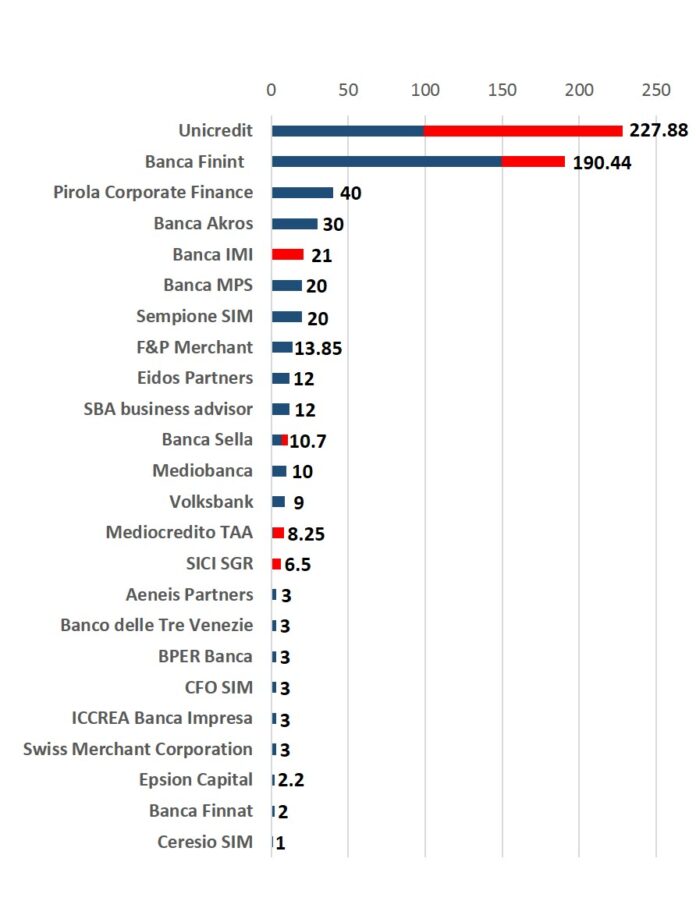 In this regard, according to data from the Minibond Observatory of the Politecnico di Milano (Polytechnic University of Milan), in 2019 Banca Finint shone among arrangers with 33 issues and a total of € 190.44 million collected for the benefit of issuing companies. However, the annual figure is not temporary. If we consider the cumulative number of transactions recorded since 2012, the year in which this market began, Banca Finint orchestrated issues on an excellent € 861 million out of a total of € 5,500 million as at 31.12.2019.
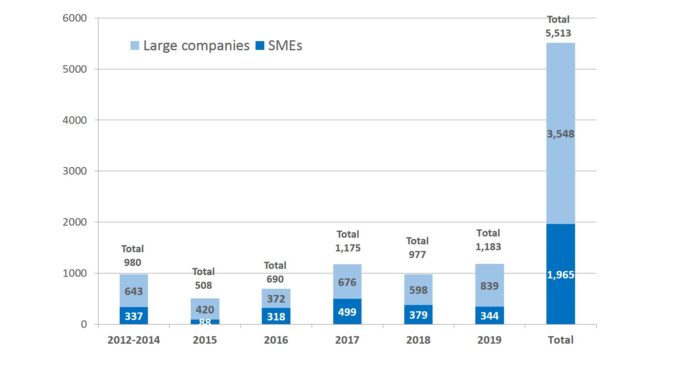 From the perspective of issuers, it is comforting to note the approval of the Minibond instrument by SMEs with € 344 million issued out of € 1,183 million during 2019. Even more significant is the number of issues by SMEs: as many as 93 issues, equal to 45% of the counter value issued in Minibond, were made for an amount not exceeding € 2 million. That is much less than what companies get for traditional unsecured financing, mortgage or leasing. If we consider that the study of the Politecnico di Milano has processed data limited to emissions of up to 50 million euros, it is clear that the Minibond instrument still has significant development prospects, with a trend since 2012 in constant growth.

Confirming this, the updated data for the first half of 2020, according to data released on 18 June 2020 by the Minibond Observatory, shows 86 issues against €270.55 million in 2019 and €270.55 million collected against €220.80 million in 2019. The Covid-19 effect will be judged with the end-of-year data, but at this point and with this mid-year trend, we can expect some pleasant surprises. It is to be hoped that the reflections induced by the post-COVID-19 effects on the Boards of Directors of companies will give further impetus to the development of this growth tool and a push towards more mature corporate finance. More evolved.
For the full report www.osservatoriominibond.it
Article edited by Stefano Barbieri, Corporate Banking Specialist