
In a society where everyone wants to appear and be famous, Banksy chooses anonymity (or did this choice give him fame and notoriety?). In fact, the name and identity of the English artist and writer, one of the leading exponents of street art, are still unknown today – despite various attempts to identify with Robin Gunningham, a student at Bristol Cathedral Choir School, now with the musician of Massive Attack, Robert Del Naja – and there are continuous comparisons and debates about who lies behind that name – it has also been assumed that Bansky is a woman or a collective of artists gathered under a ‘single identity.
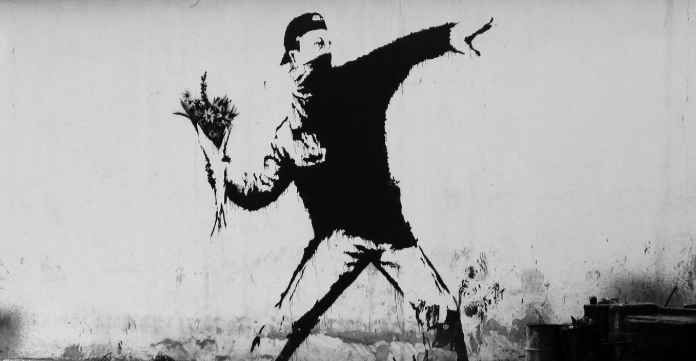
Growing up in Bristol, UK, born – supposedly – in 1974, he began his career as a freehand graffiti artist from an early age, in 1990: he used the streets of Bristol as canvases and at the time was part of a group, DryBreadZ Crewche. His first large outdoor mural is “The Mild Mild West”, painted in 1997 to cover an advertisement in the Stokes Croft neighbourhood. It represents a teddy bear throwing a cocktail molotov with three policemen in riot gear: it is the symbol of the many revolts that have marked the recent history of Bristol (the teddy bear would represent the Bristolians). Later, he adopted the name “Banksy” to disguise his identity from prying eyes and, most likely, to avoid being arrested for his illegal artistic activities. What is certain is that the name of Banksy is inextricably linked to the technique used for his murals, the stencil. This genre has long been known and appreciated by artists associated with the sphere of street art, but it was Banksy (in turn influenced by the French artist Blek le Rat) who was the first to use stencil art with such frequency and creativity that the technique achieved great global popularity, becoming himself a staple in the industry.
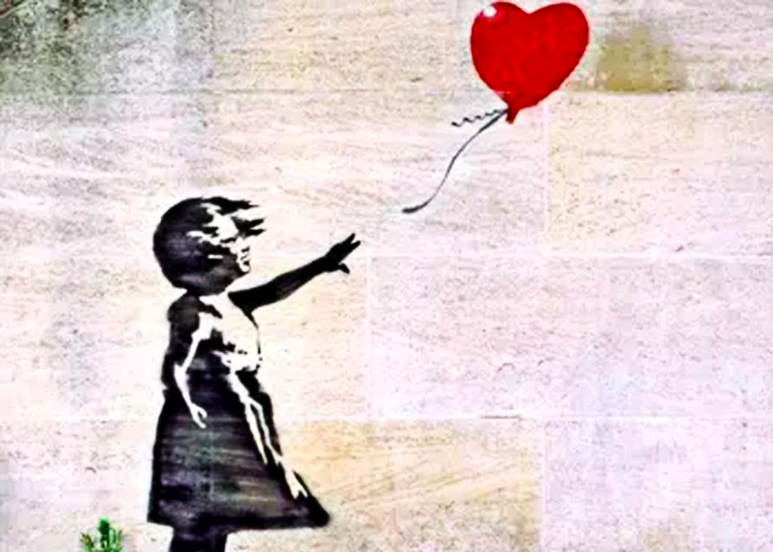
But why the stencil? Because of the slowness in the realisation of the murals, to avoid the intervention of the police, Banksy identified the solution to his problems in this technique, capable of reconciling the speed of execution – Banksy, to paint a work, takes only fifteen minutes – with great meticulousness. The artist himself expressed himself on his pictorial technique in this way: “I use what I need. Sometimes it just means drawing a couple of moustaches on a girl’s face on some billboard, sometimes it just means sweating for days on an intricate drawing. The most important factor is efficiency”.
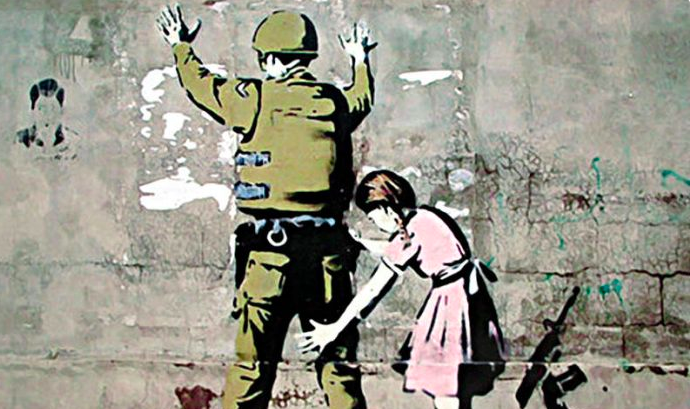
If we move from technique to the subjects of his works, Banksy ranges from the field of politics to that of culture and ethics, always analysed under the lens of irony. He transposes burning topical issues, even delicate ones, into pleasant works capable of raising the awareness of the recipients of the proposed problems and of transforming the urban fabric of Western cities into a place of reflection. A sort of “advertising poster”, usable by anyone, even children, who, together with monkeys, mice, cats, policemen, members of the royal family, on the streets, walls and bridges of cities around the world, become the privileged subjects to convey his message. How can we fail to remember the nine works that wind along the entire perimeter of the wall that separates the West Bank from the State of Israel? These are mostly children who do not want to be subject to the barrier and who try to circumvent it in flight, clinging to balloons, or to pierce it with a paddle and bucket; if this is not possible, they simply look at the earthly paradises beyond the wall through tears made masterfully with the technique of trompe l’oeil. Choice of anonymity, stencil art, but perhaps the originality of Bansky reaches its peak in the artist’s desire to create an “unsaleable” art: it is well known that he does not sell reproductions of his street graffiti, even if the auctioneers try to sell his art on the spot and leave the problem of its removal in the hands of the winning bidder. Banksy’s art, in fact, finds its maximum expression in the street and public dimension of urban space, creating pieces that document the poverty of the human condition. With an ironic and satirical approach, he deals with issues such as the absurdities of Western society, the atrocities of war, pollution, child exploitation, the brutality of police repression and the mistreatment of animals. What interests the artist is the message and its easy usability, not the commodification of his art. As a sign of protest, therefore, Banksy often goes to the most famous art galleries and clandestinely hangs works made in perfect “style” but with absolutely anachronistic details.
In this vein they are inscribed:
- “Show me the Monet” , where atypical landscape of the French master is invaded by two shopping carts and a road cone;
- “Portrait” , where an eighteenth century gentleman leaves in the background sprays against the horrors of war (installed in the Brooklyn Museum and removed after eight days);
- “Madama with gas mask” , where a 19th century woman’s face is covered with a gas mask (installed in the Metropolitan Museum of Art and removed after two hours);
- “Mural art”, drawn on a stony fragment in the manner of primitive men, but portraying a man pulling a shopping cart (installed in the British Museum, discovered after eight days and finally purchased by the latter);
- “Tesco Value Tomato Soup” , where a can of tomato soup from the supermarkets is depicted in the Warholian way.
And in a letter sent to the New York Times, the artist explained that he had spared the Guggenheim only because he was intimidated by the masterpieces on display: “I should have appeared between two Picassos – he says – and I’m not good enough to stand up to the comparison“. Banksy created his brand not only through his being a graffiti artist, but also director, painter, sculptor (one of his most famous sculptures, “The Drinker”, very much resembles Rodin‘s “Thinker”, but with a road sign on his head). The fact that he embodied all these characters led him to receive an award in 2007 for being the greatest British living artist, and, in perfect Banksy style, he did not show up to receive the award.
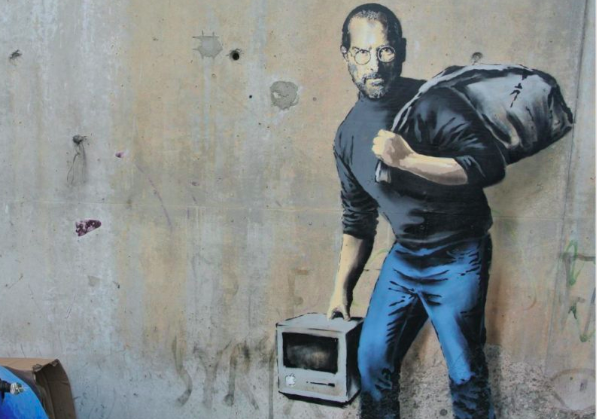
It is not known when Bansky will strike, it is known that, when he does, he will be to take the side of the weakest, to strike the hypocrisy of a capitalist system that rewards those who have already won and punishes those who break the rules, those written by the winners so that nothing changes, with the rich increasingly rich, will be to challenge the establishment, to be the battle cry of those who have no voice to defend their rights: but Banksy’s is a very particular battle cry, all his own, it’s like throwing yourself at the charge to the sound of a rock guitar, rather than at the beat of a drum.
Article edited by Massimo Basile