
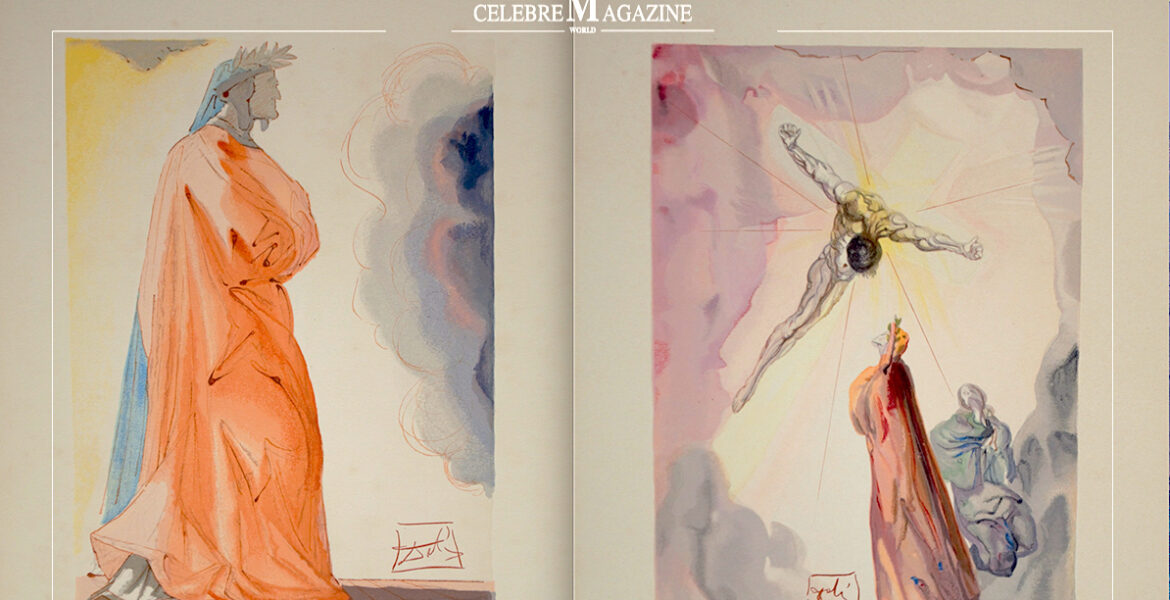
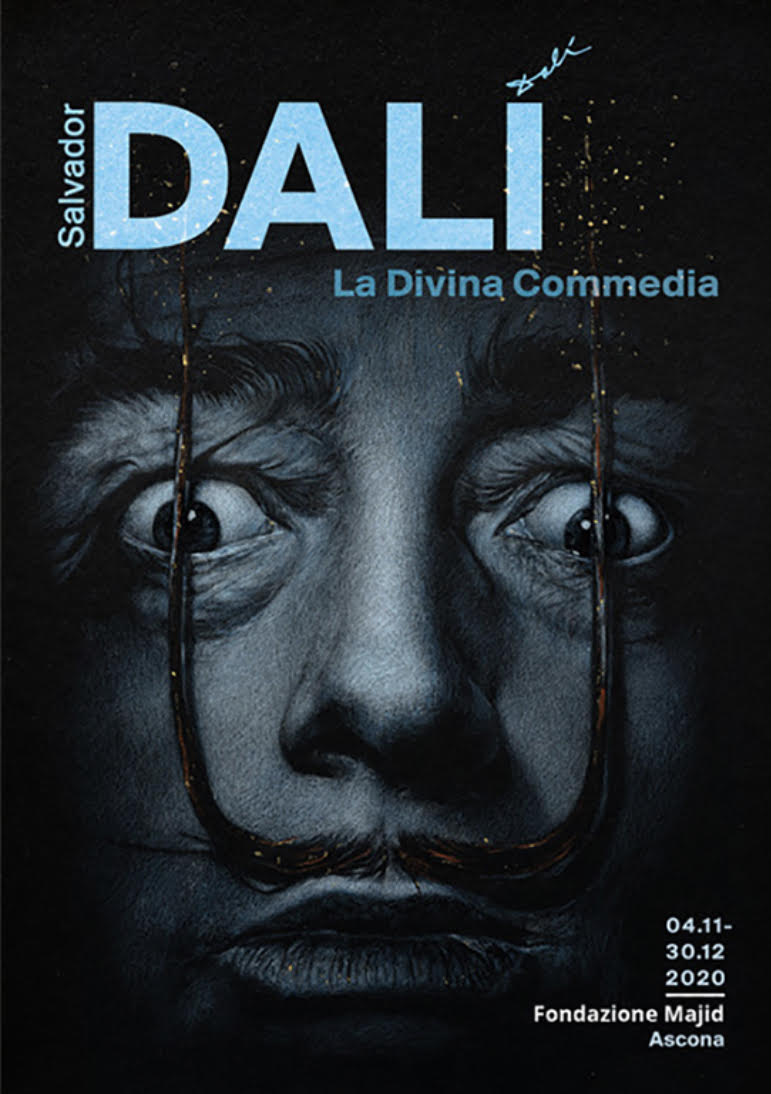
In the beautiful frame of Ascona, one of the marvellous villages in Switzerland, the Foundation Majid made this extraordinary Exhibition possible. For the first time in Switzerland, from 04 November until 30 December 2020 is possible to admire at Fondazione Majid in Ascona (on the eve of the 700th anniversary of the death of Dante Alighieri) the extraordinary 100 Artworks by the Spanish Artist: “Salvador Dalì e la Divina Commedia”.
Salvador Dalí, versatile genius, the most original and brilliant interpreter of Surrealism, he left important evidence of himself, not only as a painter and sculptor but also an illustrator. In 1950, on the occasion of the 700th anniversary Dante Alighieri’s birth, the Italian Government commissioned Salvador Dalí to illustrate the greatest masterpiece of Italian literature: “La Divina Commedia”.
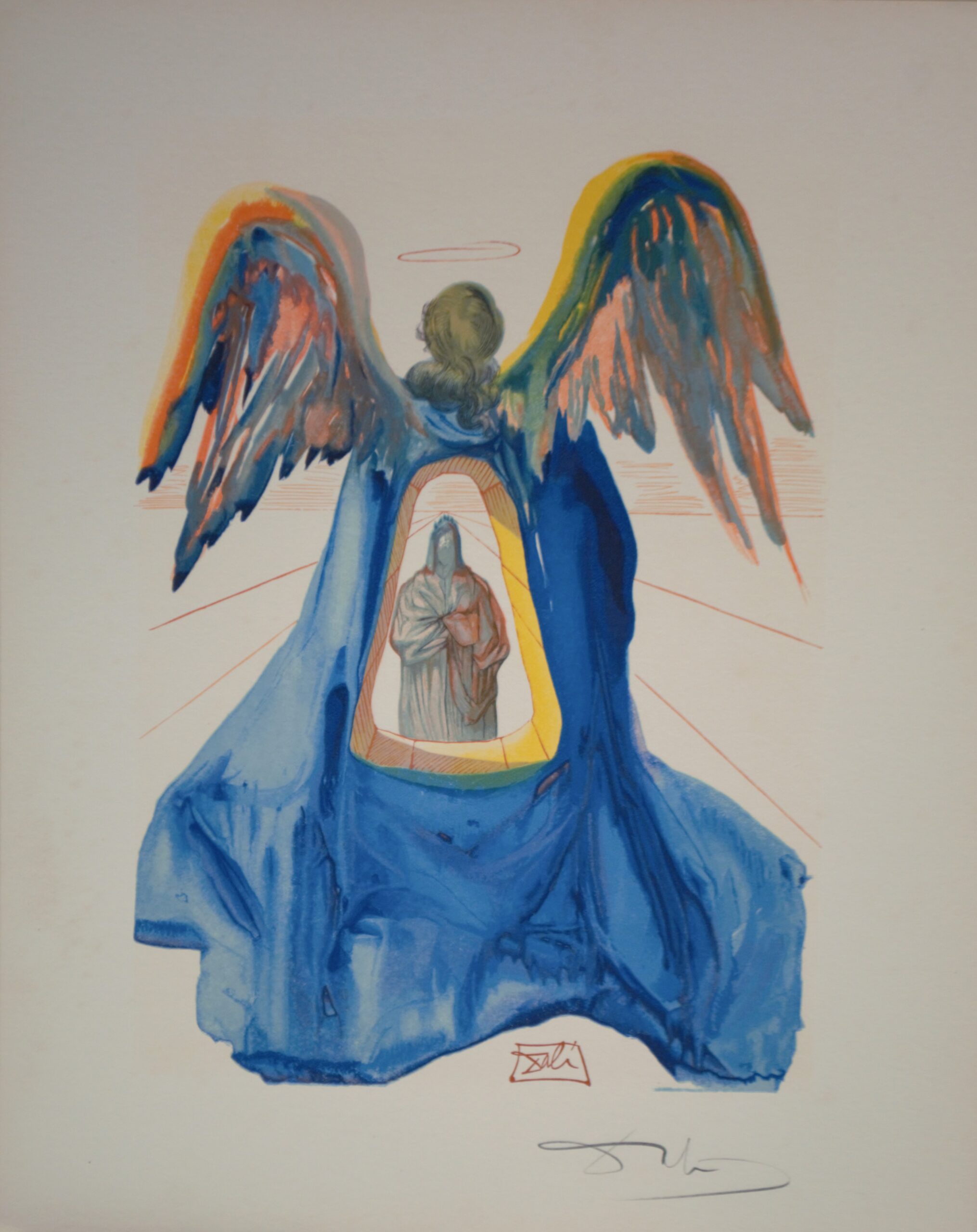
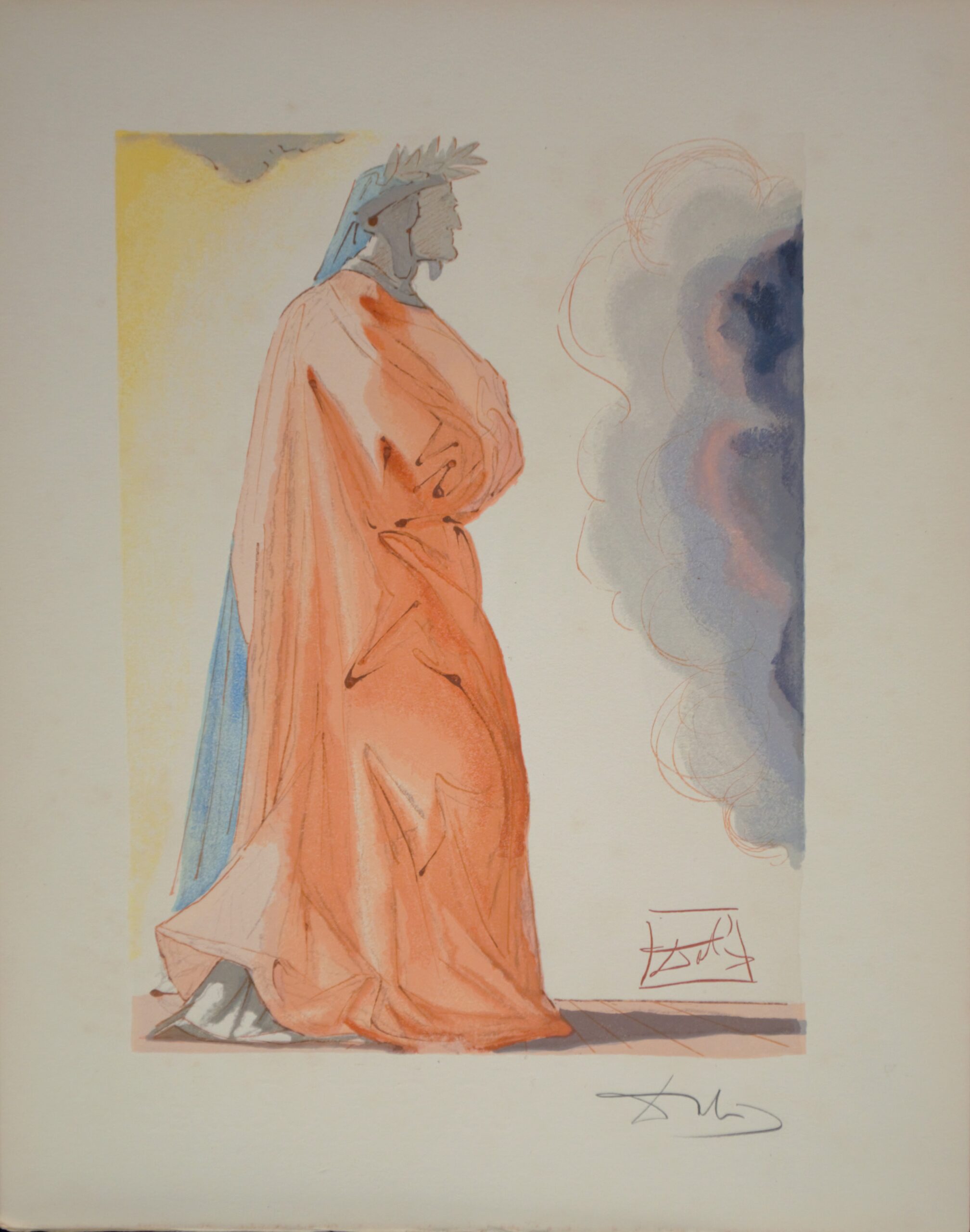
Dante in this way meets Dalí in one hundred watercolour woodcuts to illustrate the most famous manuscript by Dante Alighieri, that fantastic journey from the depths of the Hell to the splendour of Paradise passing through the purifying Purgatory; the result is a unique masterpiece suspended between dream and reality. The three books Hell, Purgatory and Paradise, are differentiated by three differently coloured areas, designed to symbolize the path taken by Dante in his most famous masterpiece. The books are divided into thirty-three poems that, with the initial introduction to the book, form a total of one hundred poems.
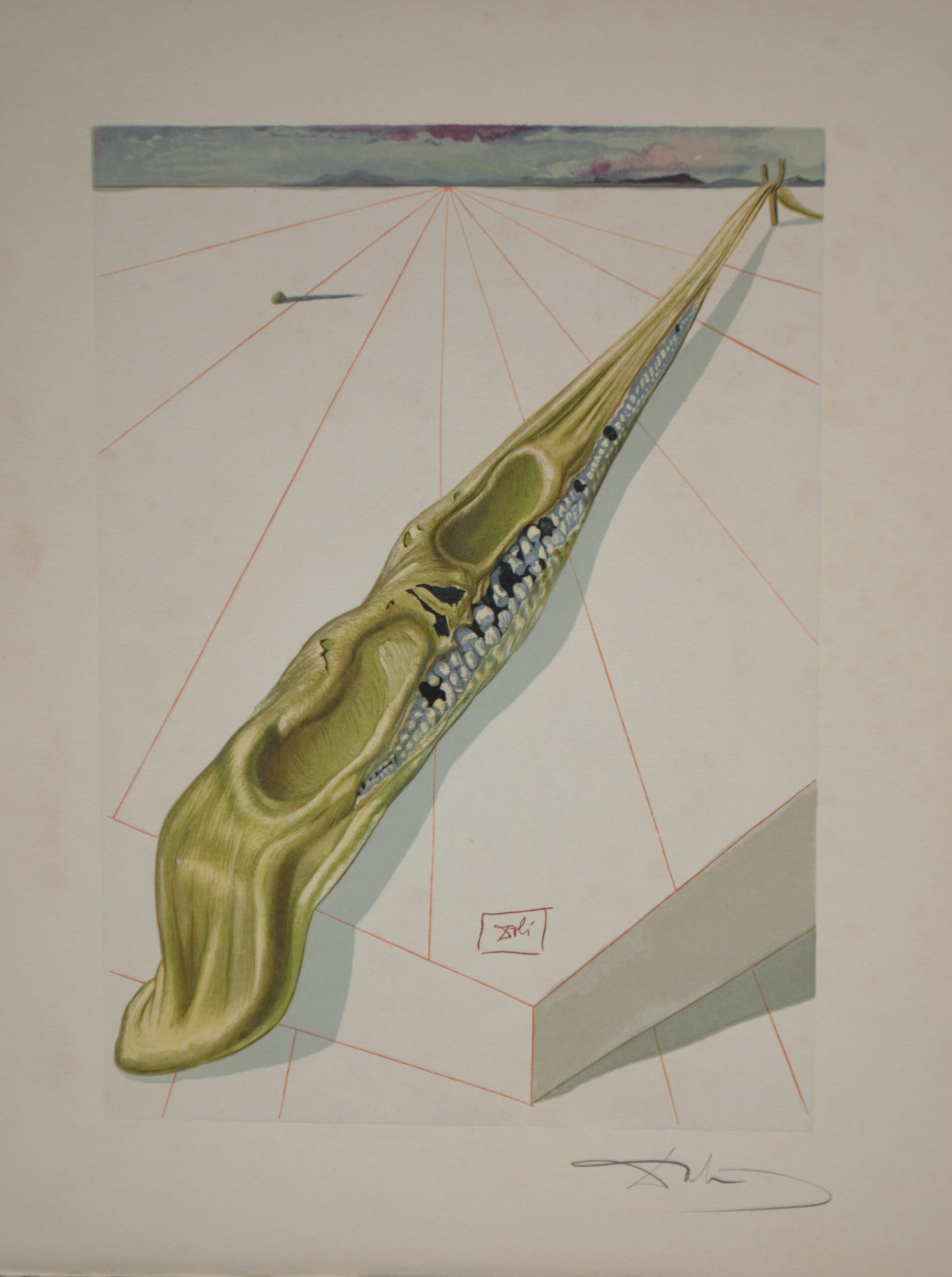
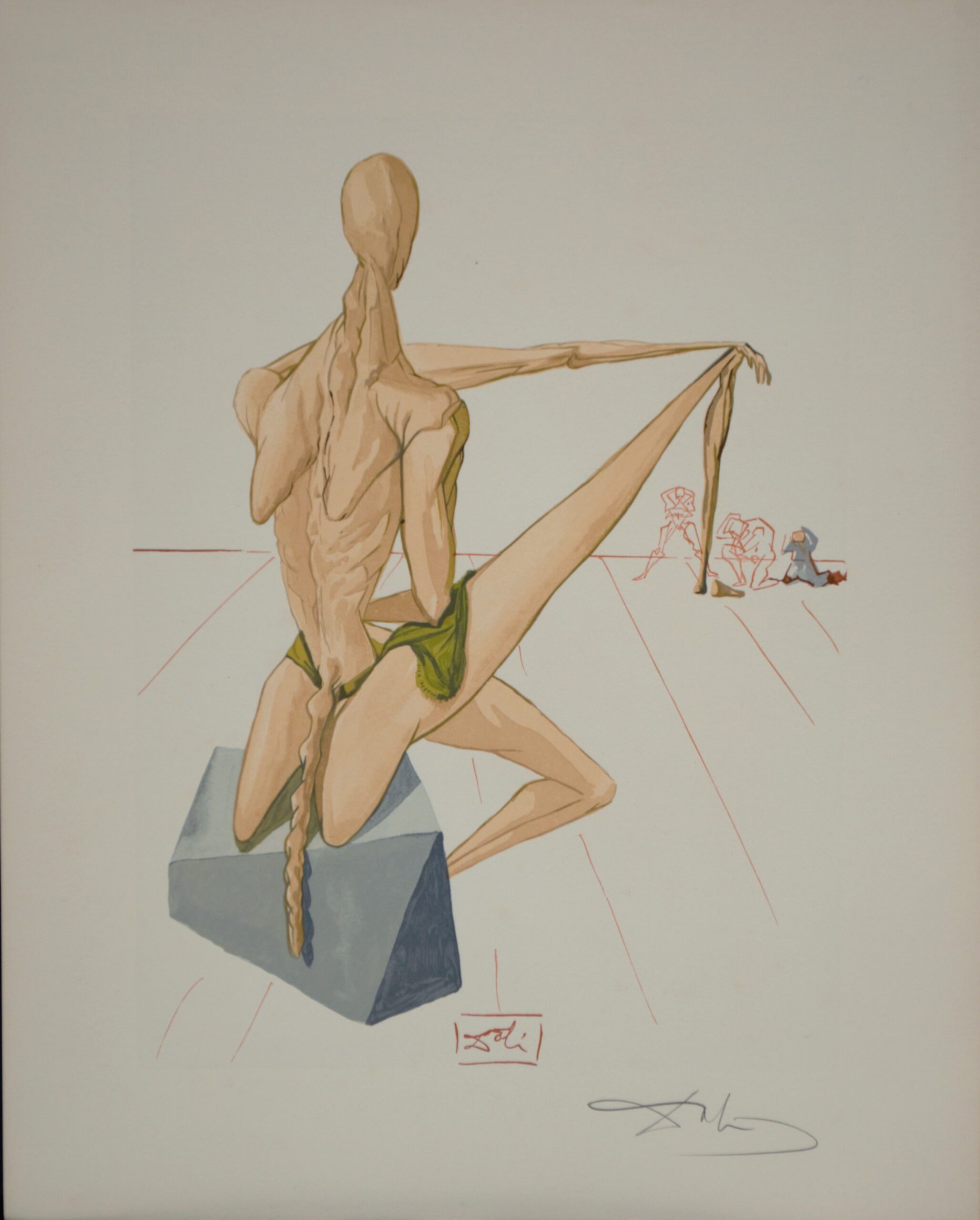
Each Dalí’s woodcut represents a character or an event corresponding to each poem placed on the corresponding Dante’s books. Figuration is often irreverent, ironic and grotesque in the representation of Hell and Purgatory; very delicate and heavenly are those of Dante and Beatrice in Paradise; the elegance of the sign is combined with a masterful and innovative use of colour, in which the artist’s pictorial research finds expression in the originality, freshness and genius of the inspiration.
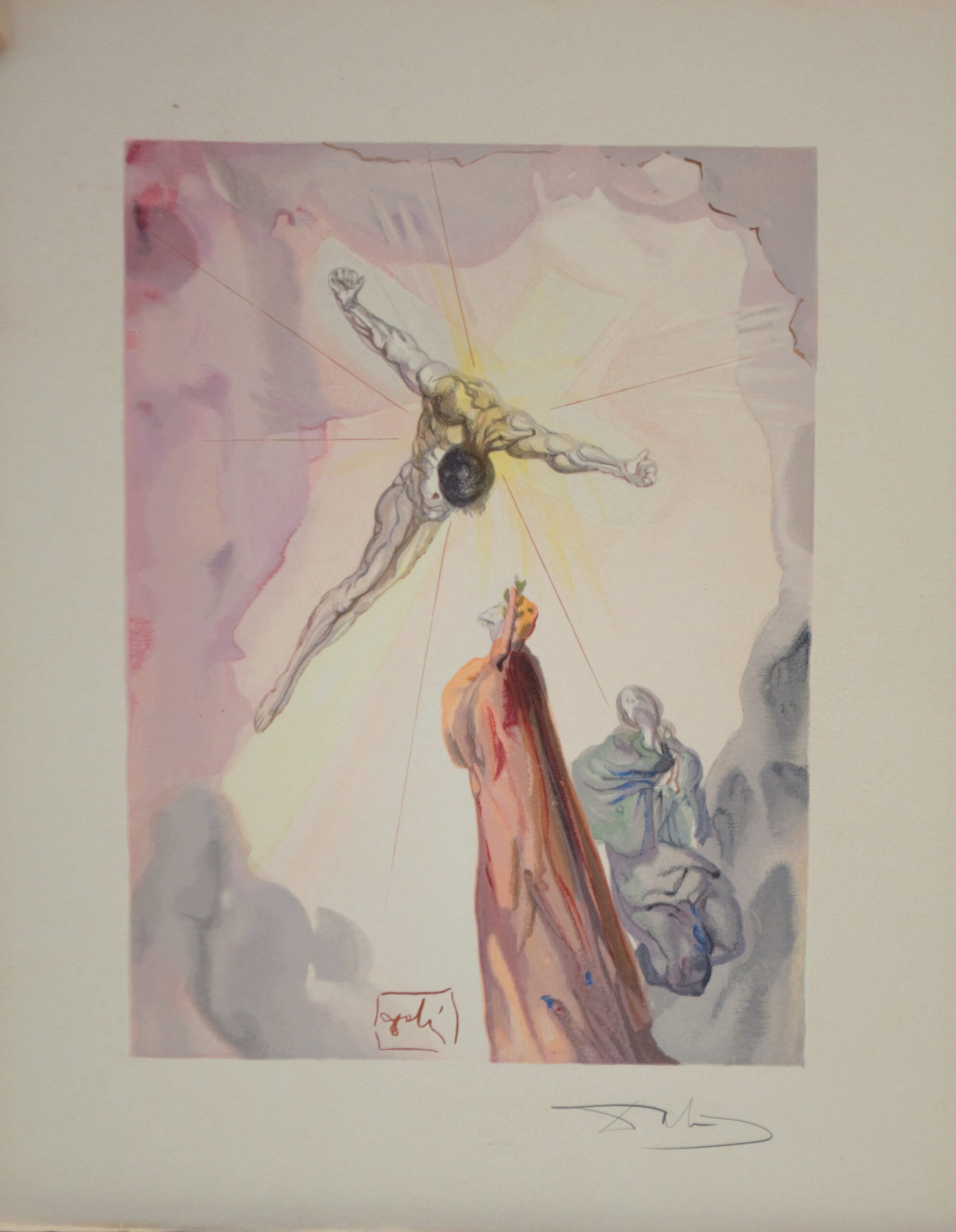
In the illustrations, Dali tells Dante’s work through a surreal and dreamlike perspective, perfectly camouflaging in Dante’s symbolic universe, the characterizing signs of his poetics: like desolate landscapes and flabby figures. Dalí manages to maintain the dreamy Dante’s atmosphere by adding his personal touch through his characteristic symbols: flabby figures, crutches and flying bones. The supernatural mixes with a bold exploration of spirituality, thus creating a unique vision of the Divine Comedy. The journey through the Dantesque world has been interpreted by Salvador Dalí with the most relevant topics of his metaphysical and mystical research, representing in an excellent way the high humanity of the Divine Comedy with an inevitable psychoanalytic gaze that explores the unconscious of the contemporary man, lost and confused like Dante at the beginning of the 1300s.
To understand more about this extraordinary and unique artwork, let us tell you more about this Great Artist. A Spanish painter, sculptor, writer, photographer, filmmaker, designer and screenwriter; he is considered one of the most significant exponents of the Surrealist movement. Creator of dream worlds, his name is synonymous with magic and remains an icon, capable already with his aspect of telling his imaginative, irrational and visionary imaginary.
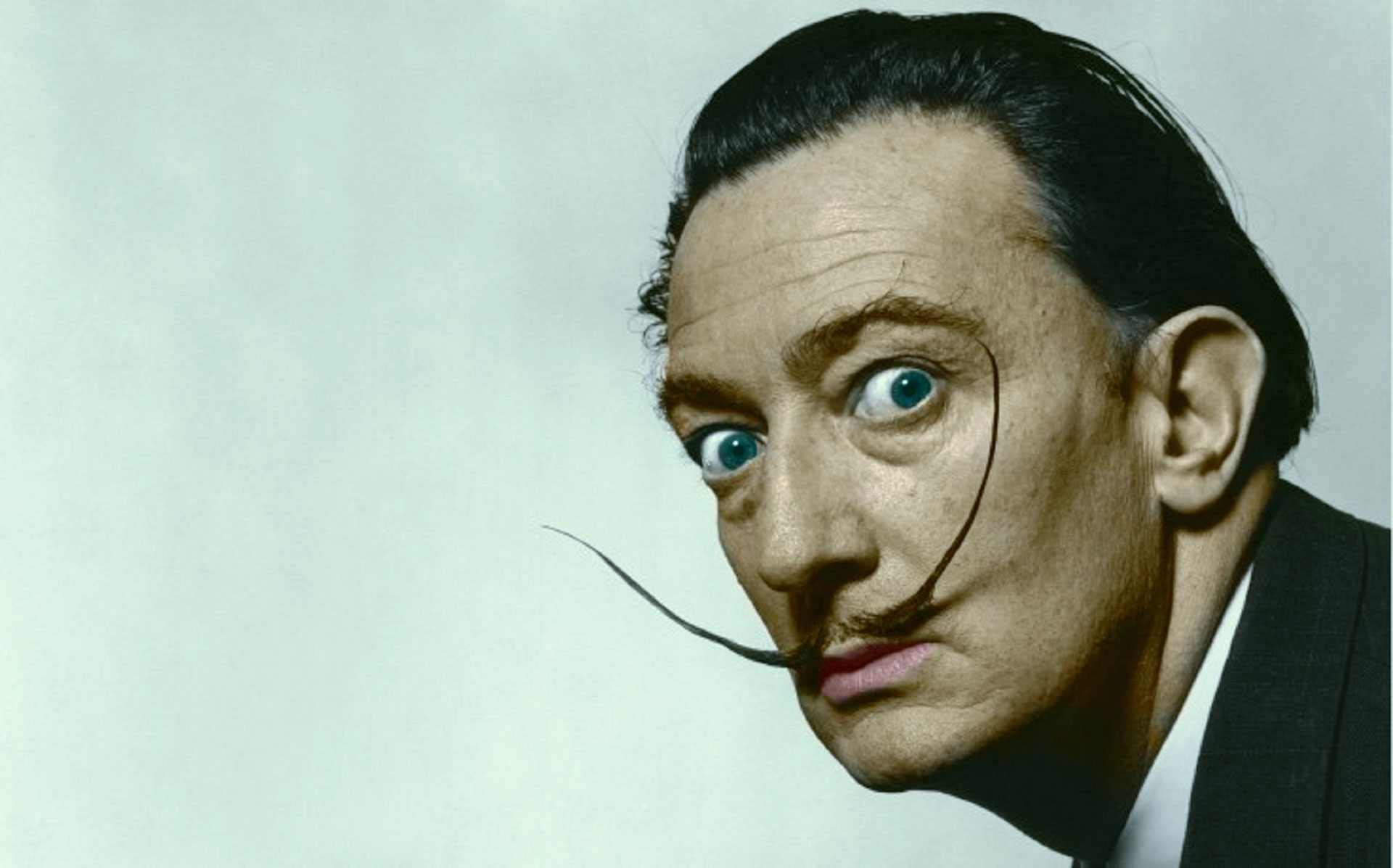
Dalí as a child demonstrated his innate artistic talent, attended an art school and was immediately influenced by the great masters of the Italian Renaissance; he led a frenetic life spending much of his time between Madrid and Paris, from which he absorbed the novelties and artistic influences of the moment. He initially approached cubism, whose influences never left him during his artistic career, he met Picasso, for whom he had deep esteem and admiration. His eccentric ways and extravagant look soon caught the attention of his colleagues and critics. His showy moustache became an unmistakable and characteristic trait of his appearance for the rest of his life.
Sigmund Freud’s theories on psychoanalysis were fundamental to the development of the Surrealist movement and had a profound influence on Dalì’s artistic production; he argued that the exploration of the subconscious was the best way to achieve the highest level of creativity. Steeped in symbolism and fantasy, Dalí’s art is constantly poised between the dream world and the real world in which natural elements and magical elements coexist in perfect harmony, making each of his works unique. Dalí was a real character, his bizarre image consisting of the omnipresent cloak, the walking stick, and the important moustache fixed upwards, remains in the collective imagination. Dalí, there are no limits; his extreme fantasy with the technical aspects makes him the most eccentric of surrealists. His statement is well known: “Every morning, just before getting up, I feel a great pleasure: that I am Salvador Dalí.”

The Exhibition “Salvador Dalì e la Divina Commedia” will be presented to the press on 4th November, 11.00 at the Fondazione Majid – Ascona. The event will be introduced by:
Luca Pissoglio, Major of Ascona
Michela Ris, Head of Ascona Culture Department and member of the Foundation Majid Board
Massimo Basile, Executive Project Manager of Foundation Majid
Bruno Zazio, President of Dante Alighieri Foundation – Locarno
After the press conference, the Exhibition will be officially open to all visitors who desire to admire these incredible and unique Artworks.
Article edited by Alexander Elisab