
Imagine a president unveiling what many would call the most beautiful coin in American history, only to have the country erupt over what wasn’t on it. That’s exactly what happened in 1907. The missing piece was just four words long, and two of them mattered most. The phrase was In God We Trust. It had appeared on American coins since the 1860s, and most people assumed it always would. When a stunning new gold coin arrived without it, newspapers, preachers, and politicians reacted fast. The outrage was immediate. What followed was a fierce debate about faith, art, and government power. Surprisingly, the man who removed the motto was a deeply religious president. His reasons were far more complicated than critics assumed, and the fallout reached all the way to Congress.
The President who wanted more beautiful money – Theodore Roosevelt thought American coins looked dull. He admired the bold, sculptural coins of ancient Greece and wanted the United States to produce money with that same artistic power. So he recruited Augustus Saint-Gaudens, the most celebrated sculptor in the country. Saint-Gaudens agreed. The two men shared a grand vision. Saint-Gaudens designed a striding Liberty holding a torch and olive branch on the front, with a soaring eagle on the back. The earliest coins were struck in dramatic high relief, with the date in Roman numerals. It looked like nothing else in American pockets. Saint-Gaudens didn’t live to see the finished coins. He died of cancer in August 1907, shortly before they were released. Yet his design endured, and collectors today still treasure the $20 Saint Gaudens as a masterpiece.
Why “In God We Trust” disappeared – Here’s the twist. Roosevelt didn’t drop the motto because he opposed religion. He dropped it because he respected religion. In his view, putting God’s name on everyday money cheapened something sacred. He went so far as to call it irreverence that came dangerously close to sacrilege. Faith deserved better. Think about where coins end up. They change hands in saloons, gambling halls, and shady deals. Roosevelt felt that stamping a sacred phrase on objects used for such purposes did positive harm to faith rather than honoring it. He also had a legal point. No law at the time required the motto on these coins, so leaving it off wasn’t against the rules. To Roosevelt, the decision seemed reasonable, principled, and fairly minor. He badly misjudged how the public would feel.
The public backlash – The reaction was swift and loud. Many Americans saw the missing motto as an attack on faith, or at least a troubling abuse of presidential power. Ministers condemned it from the pulpit, and newspapers across the country covered the growing uproar. Tempers flared. Congress quickly jumped in. Lawmakers held hearings and moved legislation to restore the motto to the gold coins that had previously carried it. Public sentiment was overwhelmingly on their side, and the bill passed easily through both houses. The vote wasn’t even close. Roosevelt recognized he’d lost the fight. He withdrew his objections and signed the bill into law on May 18, 1908. The Mint soon cut the motto into the design, placing it on the reverse. The godless coin, as some critics called it, was finished.
What makes the no-motto coins different – The main difference is easy to spot. Flip one over, and the space above the sun on the reverse sits empty. Later coins carry In God We Trust in that area. That single absence turned an ordinary production run into a famous chapter of history. The no-motto coins were struck in 1907 and 1908. By the time the law passed, the Philadelphia Mint had already produced most of its 1908 double eagles without the motto. That’s why 1908 Philadelphia examples remain the most familiar no-motto pieces. Collectors really love these coins for good reason. They represent a short-lived type created during a genuine national controversy. Each one holds nearly an ounce of gold, carries Saint-Gaudens’ celebrated design, and tells a story that still sparks conversation more than a century later.
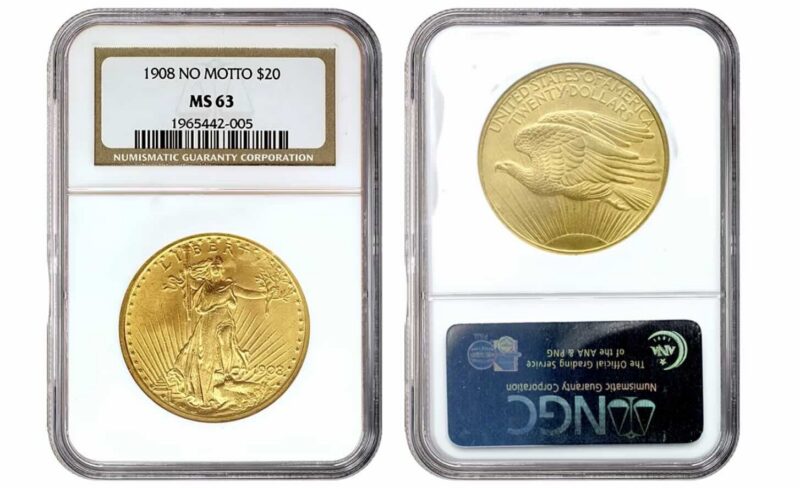
It’s remarkable how much passion two little words could stir. A president’s sincere belief that money was the wrong place for God’s name ran headlong into a public that saw the motto as part of national identity. Neither side was willing to back down. Not initially. The episode revealed deeper questions that still echo today. What role should religion play in government symbols? Who gets to decide what appears on a nation’s money? And how much should personal conviction shape public policy? Those debates never fully disappeared.
Congress settled the matter, and the motto returned. But the coins struck without it survived as tangible reminders of that moment. They prove that even a small design decision can carry enormous meaning when it touches what people hold sacred.
Article edited by Alexander Elisab