

Maranello, 21 July 1987. Enzo Ferrari unveiled to the world a racing car homologated for road use, the last one personally approved by Il Commendatore before his passing. That day marked the beginning of a legend. Writing about the F40 today, just as then, remains an exhilarating and compelling experience, for it is an absolute masterpiece, a true work of art resting on five-spoke split-rim wheels with a single central locking nut.

Following the presentation of the 288 GTO in 1984, Ferrari began conceiving an even more high-performance car destined for Group B: the GTO Evoluzione. This was an extremely powerful model featuring extensive use of composite materials and a dedicated aerodynamic setup, with a refined mechanical configuration capable of delivering 650 hp and reaching a top speed of 370 km/h. Only five units were produced. It served as a laboratory for the future flagship model that Ferrari would unveil to celebrate its 40th anniversary. Thus, the F40 was born, immediately achieving iconic status.
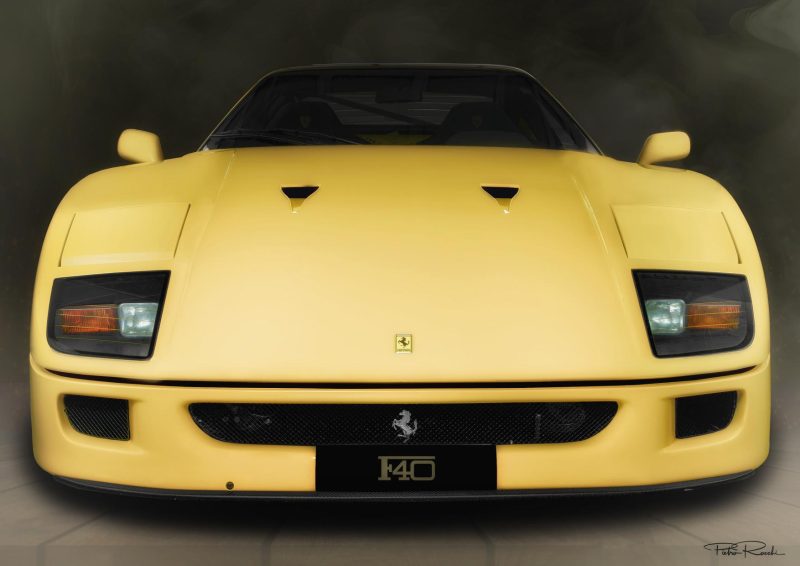
The unveiling left everyone in awe and marked a milestone in the world of supercars, creating a distinct before-and-after moment in automotive history. Its design radiates pure dynamism, with bodywork that openly reveals an extraordinary mechanical layout, uncompromising and unapologetic. Even at a standstill, the F40 exudes character. The long, sloping bonnet features pop-up headlights positioned above primary lighting functions housed under a transparent cover, with two NACA ducts in the central section. Recessed doors relative to the wheel arches define the side profile, a large air intake integrated with the rear fender, and a secondary, smaller intake below. The rear fender boasts another upper NACA duct, while grooves at the base of the wing aid in heat dissipation. The F40 logo is subtly positioned on the lower section of the rear. A black lower trim runs along the entire body, serving as a visual break and a separator for the opening panels.
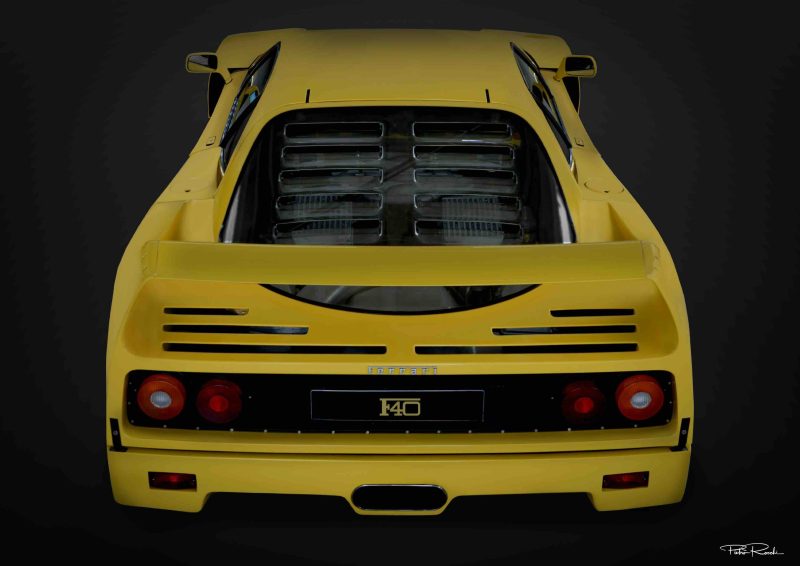
The engine bay is enclosed by a Plexiglas cover with two rows of louvers designed to vent the immense heat generated by the mechanical components, all integrated into a monolithic rear clamshell that incorporates the F40’s signature large fixed rear wing. The wide, fully permeable rear grille provides a glimpse of the powerplant and plays a crucial role in dissipating the heat produced by the substantial exhaust manifold. The rear end features the classic quad taillights and a centrally positioned recess for the number plate, while the lower section houses three centrally mounted exhaust pipes. Every aspect of this car speaks of unadulterated performance.
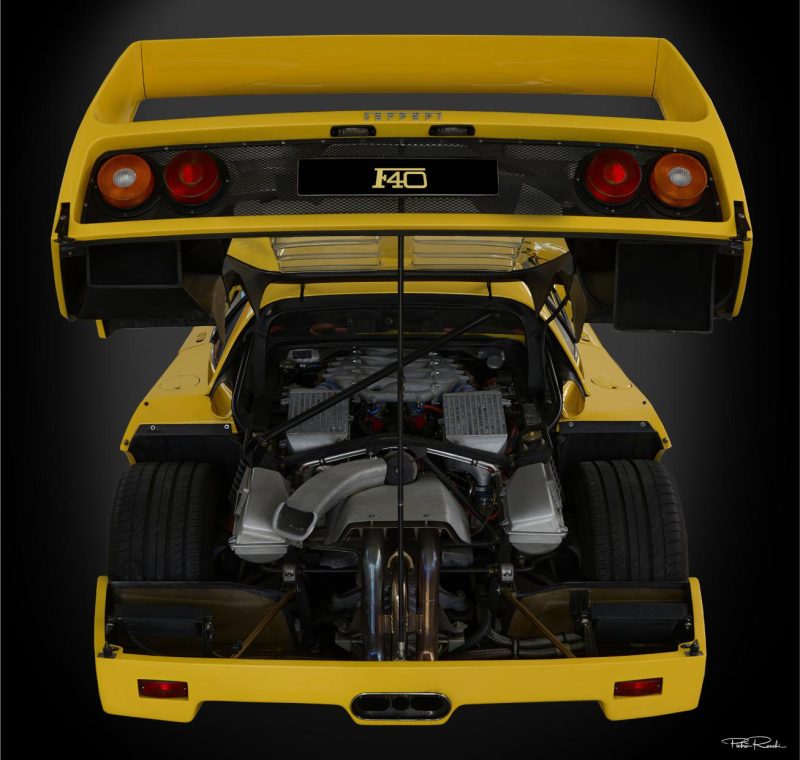
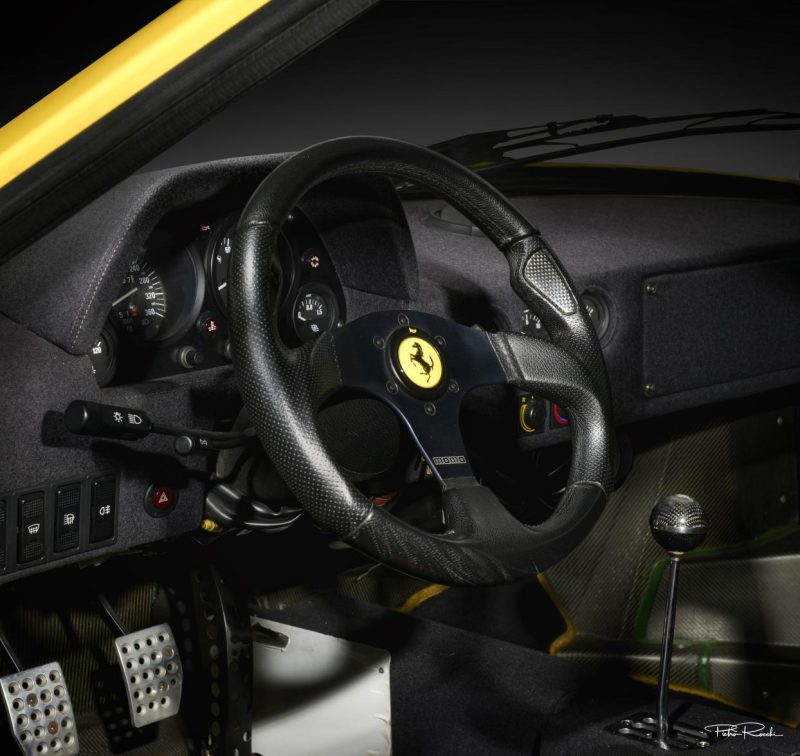
Seeing this supercar in person is a magical experience; everything is purpose-built and performance-oriented. The interior is a testament to its racing DNA, with a three-spoke steering wheel, carbon-fibre seats upholstered in Nomex, a fire-resistant fabric, and four-point harnesses. The full instrumentation is housed under a cowl, with three additional gauges centrally positioned, all entirely analogue and focused on driver engagement. The exposed polished aluminium gearshift gate guides the manual transmission’s lever. At the same time, the door opening mechanism is a simple pull cord recessed into the inner panel, which also serves as a storage pocket. Initially, the F40 did not feature roll-down windows, only sliding glass panels, to minimise weight, which was kept to an astonishingly low 1,100 kg. Exposed carbon fibre dominates the cabin, with only a few elements covered by dark anthracite carpeting. Discussing its mechanical specifications and performance is a nostalgic journey through the pinnacle of 1980s and 1990s engineering: a mid-mounted, longitudinally positioned 2.9-litre V8 engine with a 90-degree architecture, twin turbochargers, and an output of 478 hp. The F40 could reach a top speed of 324 km/h, accelerate from 0 to 100 km/h in just 4.1 seconds, complete the quarter-mile in 11.9 seconds, and cover a standing kilometre in 20.9 seconds. In 1987, it was the fastest road car in the world.
From day one, the F40 demonstrated its raw capability. This was famously showcased in a television segment filmed during its earliest production months on the A1 motorway linking Modena and Milan. At the wheel was then, Formula 1 Ferrari driver Michele Alboreto, who executed an overtaking manoeuvre with a dramatic burst of flames from the exhaust, vanishing in a split second from the director’s chase car only to wait for them at the next service station. Unsurprisingly, the F40 instantly drew a crowd of curious motorists, all under the watchful escort of the Italian Highway Police, who ensured the safe execution of the high-speed filming sequence.
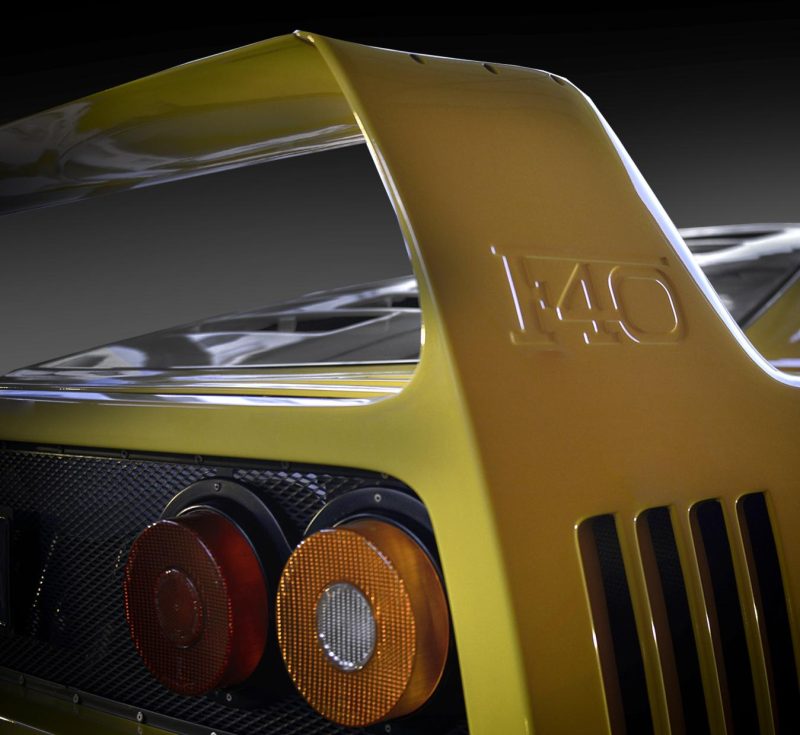
Production concluded at 1,311 units, far exceeding the initially planned 400. Since 1987, this supercar has continued to be revered worldwide and remains a treasured piece in prestigious collections. This supercar is a pure driver’s car, designed for seasoned enthusiasts. Each owner has their unique F40; however, some purists wished for different colour options or custom configurations. Yet, every F40 left the factory in red. Though wishes occasionally come true, as was the case for the owner of this stunning example, finished in Giallo Modena.
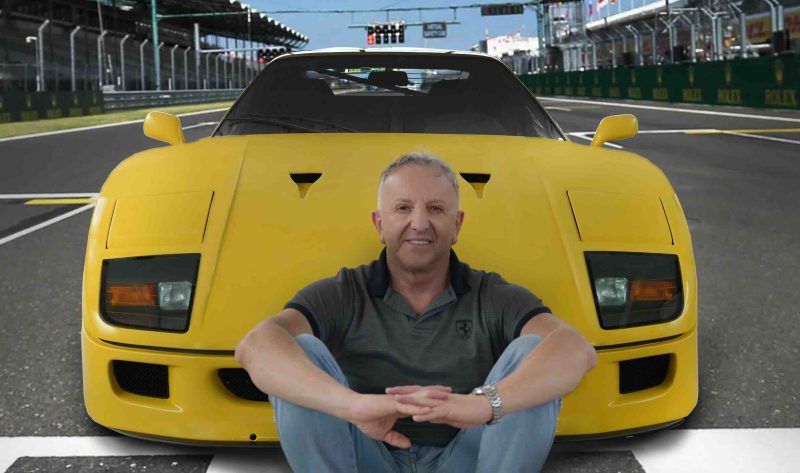
The Ferrari F40 in the photographs is from 1991 and belongs to collector Mauro Raccanello. It has been carefully finished in an appropriate colour tone. The colour change was officially authorised by Ferrari.
Gerhard Berger once wryly remarked: “The Ferrari F40 is very easy to drive… for those experienced in race cars.”
Photo Credit: Pietro Rocchi

Article edited by Antonio Erario